Finding, recording and learning collocations
1 Finding collocations
There are two main ways in which we can find collocations
- We can train ourselves to notice them whenever we read or listen to anything in English.
Look at the collocations that are worth learning from this short text in English.
After giving Mark a lift to the airport, Julie made her way home. What an exciting life he led! At times Julie felt desperately jealous of him. She spent her time doing little more than taking care of him and the children. Now her sister was getting divorced and would doubtless be making demands on her too. Julie had promised to give her sister a call as soon as she got home but she decided to run herself a bath first. She had a sharp pain in her side and hoped that a hot bath might ease the pain.
Get into the habit of making a note of any good collocations you come across in any English text you read.
- We can find them in any good learner’s dictionary. For example, if we look up the word sharp we will find some of these collocations
a sharp pain
a sharp bend/turn
a sharp contrast/difference/distinction
a sharp rise/increase/drop
When you look up a new word, make a point of noting it down in several different collocations.
2 Recording collocations
The best way to record a collocation is in a phrase or a sentence showing how it is used. Highlight the collocation by underlining it or by using a highlight pen.
For example: I don’t have access to that kind of secret information.
Or: Jim gave me a very useful piece of advice.
3 Learning collocations
Learning collocations is not so different from learning any vocabulary item. The key things are to:
- regularly revise what we want to learn
- practice using what we want to learn in contexts that are meaningful for us personality
- learn collocations in groups to help us fix them in our memory. We might group together collocations relating to the same topic. Or we might group collocations based on the same word, for example:
I must find a way to help him.
Can you find your way back to my house?
I learnt the hard way that Jack can’t be trusted.
Please tell me if I’m getting in your way.
You must give way to traffic from the left.
I’ve tried every possible way to get him to change his mind.
4 Exercises
4.1 Underline 11 collocations in this text
My friend Abigail is desperately worried about her son at the moment. He wants to enroll on a course of some sort but just can’t make a decision about what to study. I gave Abigail a ring and we had a long chat about it last night. She said he’d like to study for a degree but is afraid he won’t meet the requirements for university entry. Abigail thinks he should do a course in Management because he’d like to set up his own business in the future. I agreed that that would be a wise choice.
4.2 Match the beginning of each sentence on the left with its ending on the right
- She’s having a party.
- She’s taking an exam.
- She’s giving a lecture
- She’s making good progress
- She’s doing her duty
4.3 Correct the eight collocation errors in this text. Use a dictionary to help you if necessary
In the morning I made some work in the garden, then I spent a rest for about an hour before going out to have some shopping in town. It was my sister’s birthday and I wanted to do a special effort to cook a nice meal for her. I gave a look at a new Thai cookery book in the bookshop and decided to buy it. It has some totally easy recipes and I managed to do a good impression with my very first Thai meal. I think my sister utterly enjoyed her birthday.
-> In the morning I did some work in the garden, then I had a rest for about an hour before going to do shopping in town. It was my sister’s birthday and I want to make a special effort to cook a nice meal for her. I had a look at a new Thai cookery book in the bookshop and decided to buy it. It has some really easy recipes and I managed to make a good impression with my very first Thai meal. I think my sister thoroughly enjoy her birthday.
4.3.1 Corrections Summary:
made some work → did some work
spent a rest → had a rest
have some shopping → do some shopping
do a special effort → make a special effort
gave a look → had a look
totally easy recipes → really easy recipes
do a good impression → make a good impression
utterly enjoyed → thoroughly enjoyed
4.4 Look at this entry for the verb lead in the Cambridge Advanced Learner’s Dictionary.
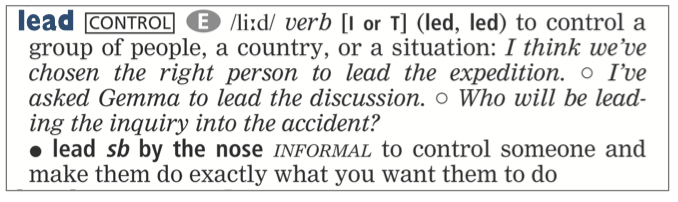
4.4.1 Collocations from the entry (underlined):
lead the expedition
lead the discussion
lead the inquiry
lead someone by the nose (idiom/informal)
4.4.2 New sentences using each collocation
- Dr. Nguyen was chosen to lead the expedition to Antarctica next summer.
- Could you lead the discussion during tomorrow’s team meeting on climate policy?
- An independent panel will lead the inquiry into the recent data breach.
- He always lets his manager lead him by the nose, never questioning her decisions.
4.5 Use a dictionary to find three or four other good collocations for each of these words:
desperately pain wise run
Write the collocations you find in an appropriate way in your vocabulary notebook.
4.5.1 1. desperately (adverb – used to emphasize strong feelings or actions)
desperately need
Many families desperately need financial support after the flood.desperately want
She desperately wants to travel abroad and study.desperately try
He desperately tried to save the relationship.desperately unhappy
After the divorce, he was desperately unhappy for months.
4.5.2 2. pain (noun – physical or emotional suffering)
feel pain
You may feel some pain after the operation.ease the pain
The medication helped to ease the pain in her joints.in great pain
He was clearly in great pain after the accident.relieve pain
Doctors prescribed morphine to relieve the pain.
4.5.3 3. wise (adjective – showing good judgment)
a wise decision
Choosing to save money early was a wise decision.a wise choice
Studying computer science turned out to be a wise choice.wise advice
She gave me wise advice about handling pressure.wise investment
Buying that property was a wise investment.
4.5.4 4. run (verb – many meanings; focus on common collocations)
run a business
He has been running a business since he was 22.run smoothly
Everything ran smoothly during the wedding ceremony.run away
The child ran away from home but returned the next day.run a risk
If you skip insurance, you run a risk of losing everything.