Process task 02
Write
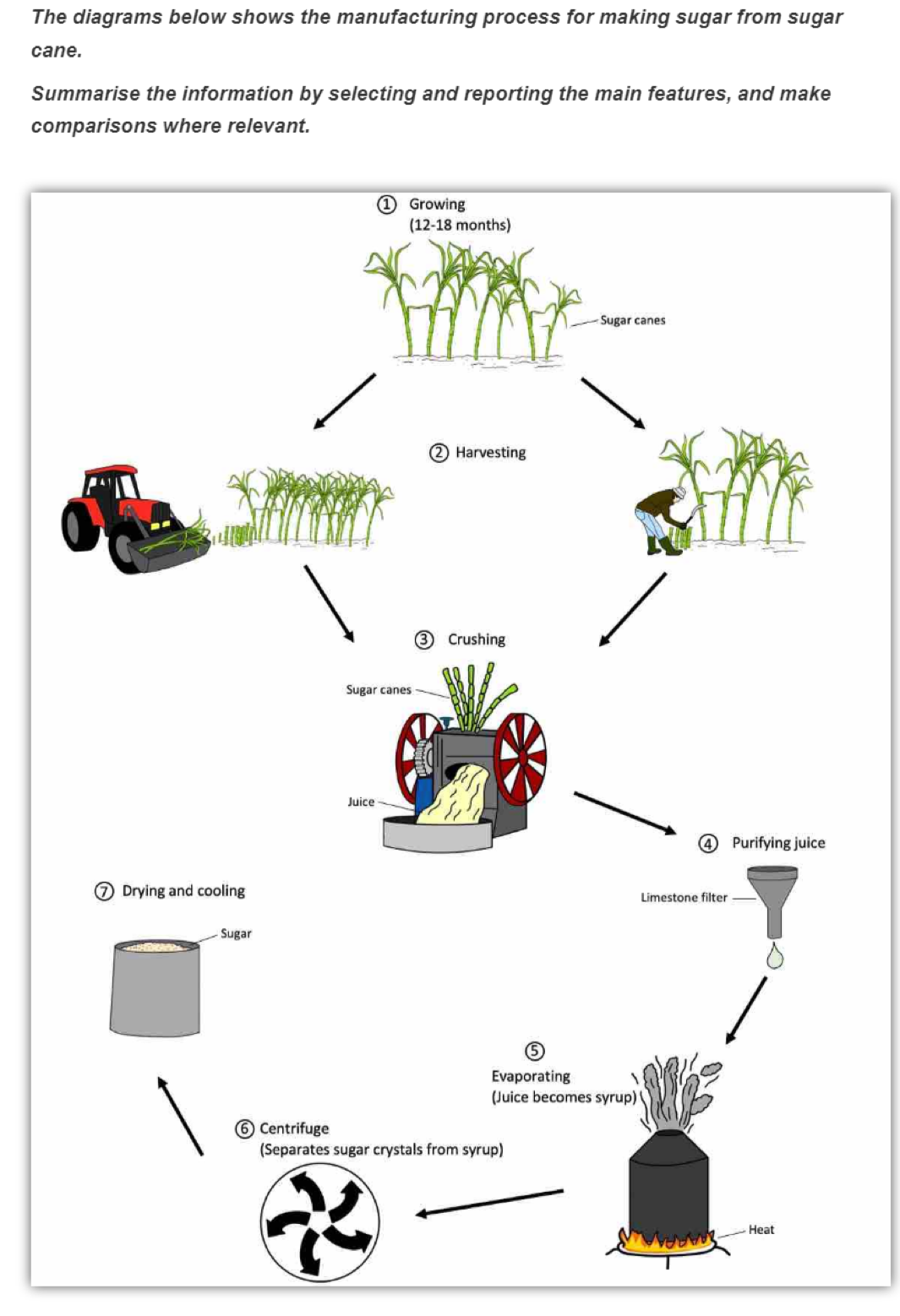
3 main stage
s1 1 2 growing and harvesting
s2 3 4 crushing and purifying juice
s3 5 6 7 evaporating, centrifuge, and drying and cooling
intro The diagrams show different stages in the manufacturing process of sugar from sugar cane.
overall
linear process, diff areas
part 1
s1
s2
part 2
s3
The diagrams show different stages in the manufacturing process of sugar from sugar cane. Overall, the linear process takes at least 12 months and comprises three main stages, each of which takes place in a different production area.
In the first stage, sugar cane is grown and nurtured for 12 to 18 months. After growing, sugar cane will be harvested by machine or by hand. It is crushed by a machine to remove sugarcane residue and produce juice. The juice then passed through a limestone filter, which removes any contaminants.
At the end of this stage, the pure juice is boiled over fire to remove excess water, after which the juice is evaporated and becomes syrup. It will undergo a centrifuge process, separating sugar crystals from the syrup. Finally, the sugar is drying and cooling to remove excess moisture.
0.0.1 1. Task Achievement (Band target: 7.0–7.5)
✅ You covered all key stages: growing, harvesting, crushing/filtering, boiling, centrifuge, drying/cooling.
✅ You provided an overview in paragraph 1 (good: mentions time, three stages, linear process).
⚠️ Some inaccuracies:
“boiled over fire” → the diagram shows an evaporator, not fire. “Boiled to evaporate water” would be better.
“At the end of this stage” → confusing, because boiling, centrifuge, drying are actually separate later stages, not part of the first stage.
⚠️ No clear separation into three main stages (grow → process → refine). You mixed processing and refining together.
Score: Band 6.5–7.0
0.0.2 2. Coherence and Cohesion
✅ Logical sequence mostly maintained.
✅ Linking words used: after that, then, finally.
⚠️ Repetition of “after …, after …” instead of varied cohesion.
⚠️ Stage grouping unclear — you don’t signal clearly where one stage ends and the next begins.
Score: Band 6.5–7.0
0.0.3 3. Lexical Resource
✅ Some good vocabulary: residue, contaminants, centrifuge.
⚠️ Awkward phrases:
“boiled over fire” → too informal.
“sugar is drying and cooling” → incorrect form. Should be “sugar is dried and cooled.”
“sugar cane will be harvested” → mixing tense unnecessarily. Present simple is better for describing processes.
Score: Band 6.0–6.5
0.0.4 4. Grammar and Accuracy
Frequent tense inconsistency:
- “will be harvested” vs. “is crushed” vs. “passed” (should be all present simple passive in process essays).
Wrong verb form: “the juice then passed” → should be “is then passed.”
Wrong voice: “sugar is drying” → should be passive “is dried.”
Sentence structure sometimes clumsy: “After growing, sugar cane will be harvested …” → better: “Once grown, the sugar cane is harvested …”
Score: Band 6.0–6.5
0.0.5 Overall Band Estimate: 6.5
Strong attempt with all stages included.
Weaknesses: grammar consistency, stage grouping, some inaccurate vocabulary.
With corrections, this could easily reach Band 7.5–8.0.
The diagrams illustrate the various stages involved in producing sugar from sugar cane. Overall, the linear process takes between 12 and 18 months and comprises three main stages: growing, processing, and refining.
In the first stage, sugar cane is cultivated and nurtured in the field for 12 to 18 months. Once mature, it is harvested either manually, using a knife, or mechanically, with the help of a harvester. The harvested cane is then crushed by a machine to extract juice, while the remaining residue is discarded. This juice is subsequently passed through a limestone filter to eliminate impurities.
Next, the purified juice is boiled in an evaporator to remove excess water. As a result, a concentrated syrup is produced. This syrup is transferred into a centrifuge, which spins at high speed to separate sugar crystals from the remaining liquid.
Finally, in the refining stage, the sugar crystals are dried and cooled to remove any residual moisture. At this point, the refined sugar is ready for packaging and consumption.
1 The difference between trends steps and stages
This lesson deals with a different type of process: the manufacturing or making of something. Although we are dealing with one specific product (sugar), the same approach can be used with any task where we are shown the different steps in a process.
1.1 Points to notice
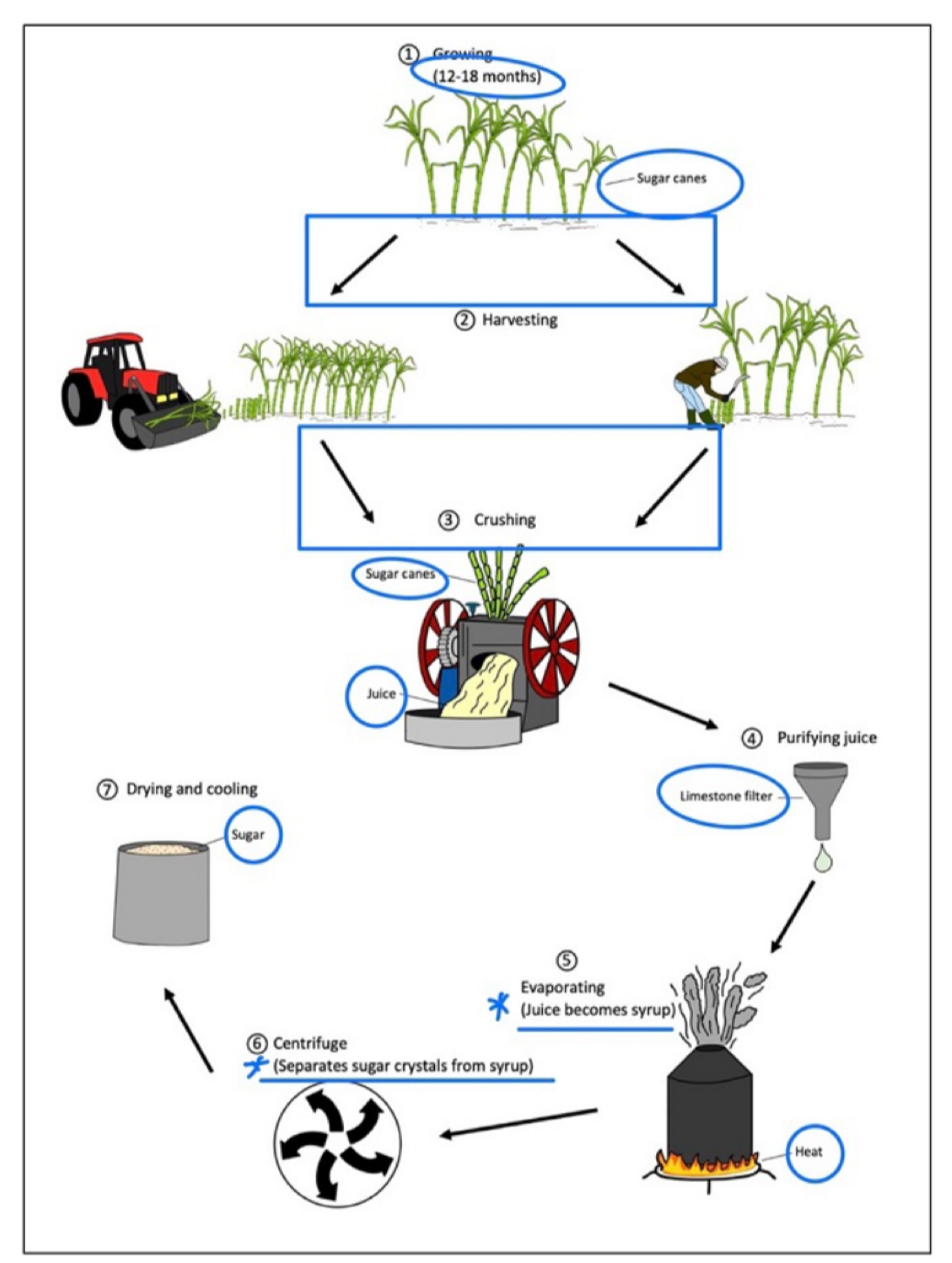
- The length of time - this is only given in step 1, so we don’t know how long the other steps take.
- The names we are given: e.g. sugar cane, juice; limestone filter, syrup, heat, sugar crystals, sugar.
- Notice that with sugar cane, we can use the plural to write about the individual canes (as in the diagram) or the singular to write about the crop (as in the question).
- Notice the different arrows - In particular, those showing that there are two ways of harvesting the crop.
- In step 5 and 6 we are given extra information about what is happening.
- Notice that ‘centrifuge’ is a noun not a verb (there is no ‘ing’ at the end)
1.2 Stages and trends
As we saw in lesson 9, process tasks have stages rather than trends, and it is these stages that we must highlight in our body paragraphs and summarise in our overview. We identity a trend by looking at the beginning point in the data. A common problem in process tasks is that, in their overview, candidates often mention only the first and the last stage in the process, thus confusing a stage with a trend. Look at the following example:
The process consists of seven steps of various time length, starting by farming sugar canes and ending by dry sugar ready to use.
It not very helpful here.
There is an overview presented in the first paragraph which summaries the process into the farming stages and the drying stages. This summary could be more detailed, e.g. farming, crushing, separating and drying stages.
It is true that this is not a complete or clear overview because we do not get a clear picture of what happens between the farming of the sugar canes and the dry sugar at the end. However, the use of the word ‘detailed’ is unfortunate here. It would have been better to say that the overview needs to include more information in order to be a clear or complete overview.
Listing four of the steps in the diagram as example (e.g. farming, crushing, separating, and drying stages) also suggests you should include these words in our overview, which is not a good idea as they are given in the question. Later in this lesson we will look at how to avoid using words from the question paper, which is very important. In PC view, this advice is better expressed as follows: There is an overview presented in the first paragraph which mentions two stage: farming and drying. A clearer summary would give an overview of the main stages rather than just the first and the last steps in the process.
In a process task, be very careful not to just copy the words and phrases used in the diagram.
1.3 How to identify the main stages
To identify the main stages in a process, we need to do more than just look at the beginning and end. Instead, we need to look at the different steps in the process and see if we can group them together in some way. This will help to categories them. With our current task, PC identified two main stages, each of which involves more than one step. Can you identify the two categories from the following list? NB The words you choose should umbrella terms rather than one specific step
Crushing Drying Evaporating Farming Growing Harvesting Processing Purifying Separating
| Farming | Processing |
|---|---|
| Growing | Crushing |
| Harvesting | Drying |
| Evaporating | |
| Purifying | |
| Separating |
1.4 Steps and stages
In lesson 4.2, PC recommended asking ourselves questions about a diagram, like this:
Q: What are being shown here? A: This diagram is showing the steps involved in …
A step is one part of a process. Here are some useful phrases with the word ‘step’:
- When learning a new skill, it is best to do it one step at a time. = (slowly and deliberately)
- I will explain what you need to do step by step. (=giving instruction in a logical order)
- Changing the resources you need to use to practice is a step in the right decision. (= a good starting point)
The word ‘stage’ has a broader meaning:
We’re renovating the house in stages, we’ll start with the downstairs areas, then do the upstairs rooms, and finally the area outside the house.
This mean than we can say that the diagram shows seven steps in a process, but we can also group these steps into key stages. This is very helpful in producing a clear overview, but we need ask a second question:
Q 1: What are we being shown here? Ans: The diagram shows the steps involved in a process.
Q 2: What are main stages in this process?
Looking carefully at the diagram will help. One easy way to decide a ‘main stage’ is to look at the product or material being processed and noticing when it changes in form (e.g. from a plant to a juice). This means that, we need to notice:
- What type of process it is (e.g. mechanical, manual)
- How many steps there are
- Where the process takes place
- the product and how it changes
- whether any of the steps can be grouped together into key stages
In our current diagram there are seven steps numbered 1-7, but they are not all equal. Some are important separate stages (growing, harvesting) while others are smaller steps in a part of the process (purifying, evaporating, separating). Looking at how the product changes (from sugar canes, to juice, to syrup, then sugar) helps to group these together so that we can summarize them in a clear overview.
We can identify the main stages by grouping steps together. Remember, we are always looking for the main changes, so looking at when the product changes form can also help.
For example: the plant -> juice -> syrup -> sugar
PC’s note for this step
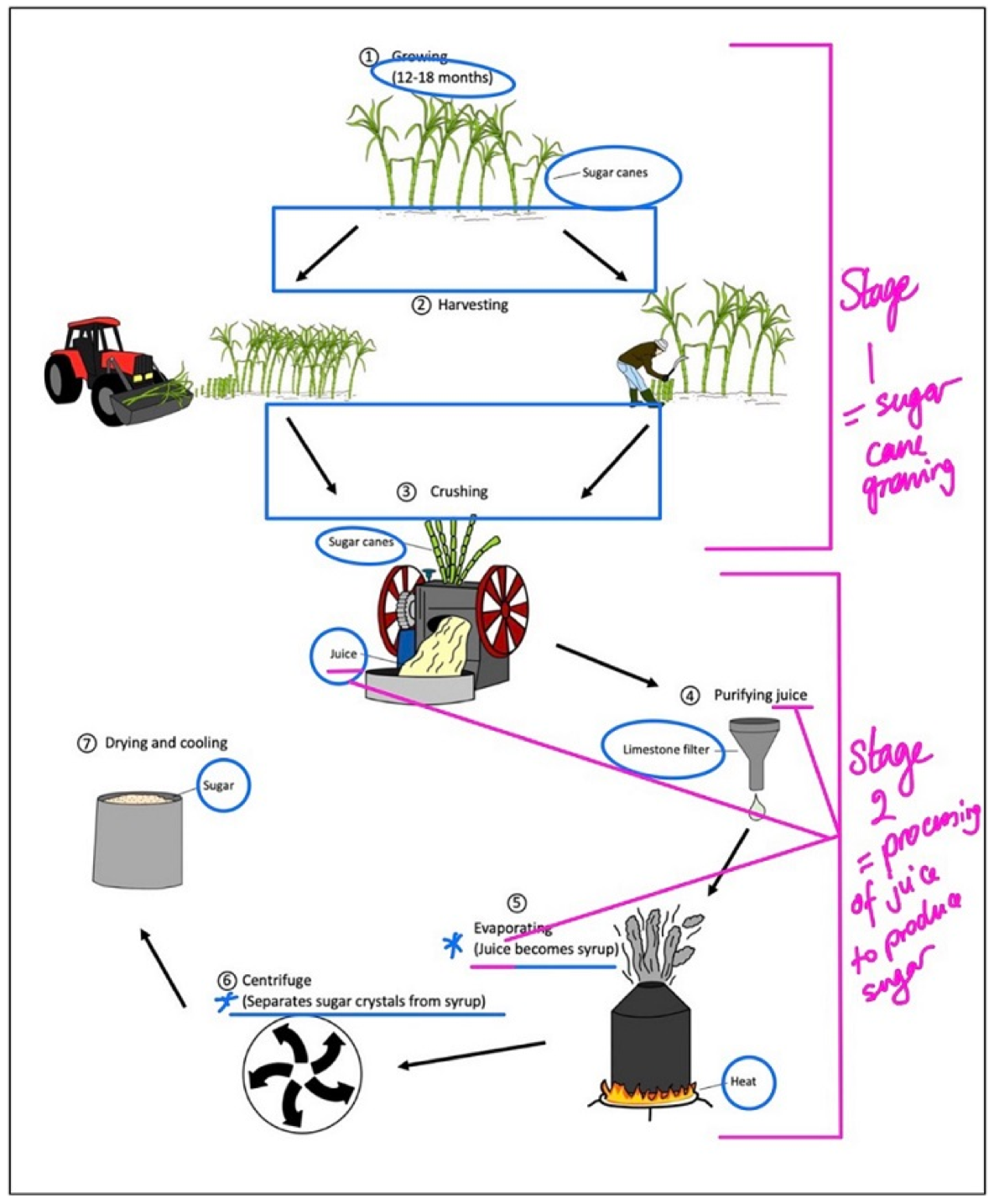
For her overview, she identified two main stages 1) the growing and harvesting the crop and 2) the processing of the juice from canes to produce sugar. To make sure our overview is ‘complete’ and ‘clear’, we can include the following
- the type of process
- how many stages there are and what these are (using umbrella terms)
- what happens during the process (without giving too much detail) i.e. the main changes
Although we can’t avoid giving some details here (e.g. sugar cane and sugar) try to avoid giving too many other details in this overview. Write our version below then compare it to her later when we look at her model.
1.4.1 Overview Practice
Try to predict what PC overview will look like by writing an overview statement that includes the following information:
- the type of process
- the number of stages and what they are (use umbrella terms)
- what happens during the process (avoid giving too much detail here)
linear process 2 stages farming, and processing
Overall, the linear process consists of two main stages, including sugar cane farming and processing of juice to produce sugar. # Changing the language in the question
Process tasks generally have more language on the question paper than other tasks. This helps us to understand what is happening but it also means we need to be careful: in order to show our language skills, we need to avoid just copying the language on the diagram.
The different steps in the process are labelled, usually with the noun form of a verbs (the ing form). For example, growing, harvesting, crushing, purifying, evaporating, drying and cooling. Steps 5 and 6 in our current diagram are unusual. Rather than adding more detail to the diagram (e.g. showing and labelling the syrup and the centrifuge), the question is tell us that, in step 5 ‘juice becomes syrup’ and in step 6 the centrifuge ‘separates sugar crystals from syrup’. So we have even more language to avoid copying here.
Repetition is another common problem in process tasks, as it is easy to use the same grammatical structures repeatedly. To solve these problems, use the language points below to build our vocabulary and our grammatical range and accuracy.
1.5 Comprise, consists of, involve
These verbs are useful for our overview. They have a similar meaning but are structurally different.
The following examples show how they are used. Make a note of any prepositions needed.
- Comprise is followed by a noun: This process comprises two main stages.
- Consist of and involve can both be followed by a noun or a verb (in the ing form)
- This process consists of two main stages.
- This consists of growing and harvesting the crop and then processing it to make sugar.
- This process involves two main stages.
- This involves growing and harvesting the crop and then processing it to make sugar.
Here is some other useful vocabulary to learn: Raw materials - this refer to the materials needed to produce something at the start of the process and in their original state.
Ingredients - this is used when the raw materials are different foods used in a recipe.
We ‘remove’ something we do not want and ‘extract’ something we do want.
- The leaves are removed from the plant before cooking.
- The juice is extracted from the plant and used to create the sugar.
The verb ‘allow’ means ‘give permission for something’, but it can also be used in a process to mean ‘to make something possible’
- Crushing the plants allows the juice to be extracted.
1.6 Changing from ing to passive
In our body paragraphs, we will need to change the ‘ing’ forms in the diagram and use the verbs actively or, more often, passively. For example:
Step 1) growing -> the sugar can is grown.
Be careful with verbs that cannot be used in the passive. Verbs like this cannot have an object. For example, the verb ‘fall’ cannot be used with an object (something can fall but we cannot fall something). So we can say:
The apples fall into a bucket.
But we cannot say:
A worker falls the apples into a bucket.
Which is why we also cannot use it in the passive
The apples are fallen into a bucket.
Instead, we would need to use the verb ‘drop’ here.
- A worker drops the apple into a bucket.
- The apples are dropped into a bucket.
Problem verbs like these are called ‘intransitive verbs’ and we will see the letter [i] in brackets next to them in a dictionary. The verbs that can have an object are called transitive and have a [T] next to them. Some verbs can be both, depending on their meaning. Other intransitive verbs to be careful of (and which cannot be used in the passive) are:
appear, arrive, become, come, disappear, go, jump
1.7 To + infinitive of purpose
In a process task, we often need to say why something is done. To + infinitive can be helpful here. For example, this sentence, ‘Seeds are planted to produce the crop’, tells us why the seeds are planted.
Practice these structures in the next exercises.
1.7.1 Exercises
Fill in the gaps in the sentences below to change the name of the stage into a short sentence.
1 Growing the sugar cane
The sugar cane is grown.
2 Harvesting the crop
The crop is harvested
3 Crush the plants
The plants are crushed
4 Extracting the juice.
The juice is extracted
5 Purifying the juice
The juice is purified
6 Separating out the sugar crystals
The sugar crystals are separated out
7 Spinning the syrup
The syrup is spinned spun.
8 Drying and cooling the sugar crystals
The sugar crystals are dried and cooled.
Put the words in the following sentences into the correct order. NB They each feature to + infinitive to show purpose

Seeds are planted to produce the crop.
Q 3
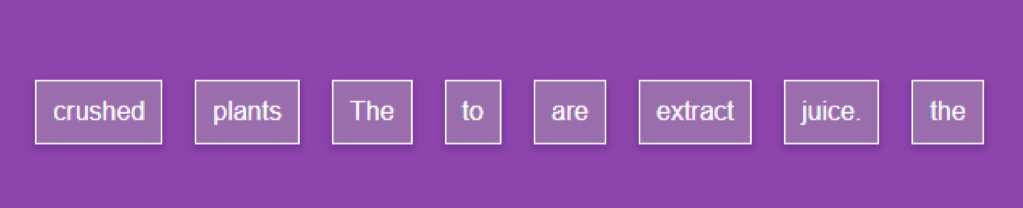
The plants are crushed to extract the juice.
Q4

The juice is passed through the filter to purify it.
Q5
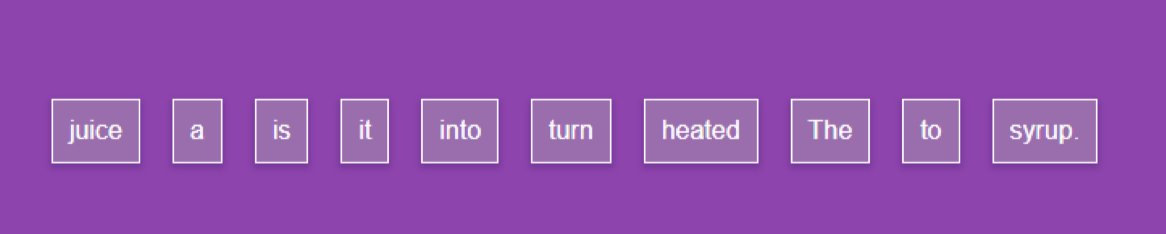
The juice is heated to turn it into a syrup.
Q6

The syrup is spun in a centrifuge to separate out the sugar crystals. #### Q7

The sugar crystals are dried and cooled to produce the sugar.
1.8 Avoid repetition
To avoid repeating the same structures, we can also use a relative clause or reduced relative clause to explain the result of a step. For example:
- The plants are crushed to extract the juice.
- The plants are crushed, which extracts the juice.
- The plants are crushed, extracting the juice.
As we saw in the vocabulary note, sometimes, we can add the verb ‘allow’:
- The plants are crushed to extract the juice.
- The plants are crushed, which allows the juice to be extracted.
- The plants are crushed, allowing the juice to be extracted.
1.9 After, Once and When
Another way to avoid repeating the same structures is to use after, once or when. This allows us to use a present perfect or present perfect passive and show a range of grammatical structures.
Look at the following examples:
- First the crop is grown and then it is harvested.
- After the crop has grown, it is harvested.
- Once the crop has grown, it is harvested.
- When the crop has grown, it is harvested.
We can vary the tense of the second clause by saying it: it can be harvested, or it will be harvested. However, we cannot use ‘will’ immediately following after, once, or when
After / Once / When the crop will be grown
1.9.1 Exercises
Q1
Fill in the gaps to rewrite the following sentences using
- a relative clause
- a reduced relative clause
- to + infinitive
- The juice is passed through a filler, to purify it
The juice is passed through a filler, which purifies it.
The juice is passed through a filler, purifying it.
- The juice is heated to turn it into a syrup.
The juice is heated, which turns it into a syrup.
The juice is heated, turning it into a syrup
- The syrup is spun in a centrifuge, separating out the sugar crystals.
The syrup is spun in the centrifuge, which separates out the sugar crystals.
The syrup is spun in the centrifuge to separate out the sugar crystals.
- The sugar crystals are dried and cooled to produce the final product.
- The sugar crystals are dried and cooled, producing the final product.
- The sugar crystals are dried and cooled, which produces the final product.
Q2
Rewrite sentences 1-5 below to practice using after, once, or when + the present perfect or present perfect passive.
- First the crop is grown and then it is harvested.
-> After / Once / When the crop has grown, it is harvested. OR: After / Once / When the crop has grown, it will be / can be harvested.
- The crop is harvested and then taken to a factory for processing.
-> After / Once / When the crop has been harvested, it is taken to a factory for processing. OR: After / Once / When the crop has been harvested, it will be / can be taken to a factory for processing.
- The crop is harvested and then crushed to extract the juice.
-> After / Once / When the crop is harvested, it is crushed to extract the juice. OR After/ Once / When the crop is harvested, it can be / will be crushed to extract the juice.
- The juice is purified and then heated.
-> After / Once / When the juice is purified, it is heated. OR After / Once / When the juice is purified, it can be / will be heated.
- The sugar crystals are separated out and then dried and cooled to produce sugar.
-> After / Once / When the sugar crystals are separated out, they are dried an cooled to produce sugar. OR: After / Once / When the sugar crystals are separated out, they can be / will be dried and cooled to produce sugar. # Model answer
The diagrams show the process used to make sugar. Overall, this is a largely mechanical process comprising two main stages: the farming of sugar cane and the processing of the crop, which turns it into a liquid and eventually into sugar.
The first stage of the process is the longest as the sugar cane takes between 12 to 18 months to grow tall enough for harvesting. Once it is fully grown, the crop can be harvested in two ways, either mechanically using specialist machinery or by hand, a much more labour-intensive method.
The second stage is wholly mechanical and involves five steps. First, the plants are crushed to form a juice, which is then extracted. The juice is purified by passing it through a limestone filter before being heated. During this step, the liquid content of the juice evaporates leaving behind a syrup. The syrup is then put in a centrifuge and spun at a high enough speed to separate out the sugar crystals, which are subsequently dried and cooled to produce the final product.
1.10 Point to notice
- PC overview mentions the two main stages and the main changes, and these are reflected in her two body paragraphs.
- She was able to make two comparisons: 1) the longest stage in the process and 2) comparising the different methods used for harvesting
- In her editing, she read her answer aloud to see if there was repetition - this lead her to change to sentences to fix the following problems: 1) a repetition of ‘then’ (Is then extracted … is then heated) and 2) in the last sentence, she had written ‘which are finally dried and cooled to produce the final product.’. Notice the changes she made to avoid this. Be sure to read through our own answer in our head if we have time at the end.
- Notice the clear coherence and cohesion in her answer. She signaled the main topic of each paragraph very clearly (The first stage … The second stage) and the information is logically organized, step by step. Try to notice the referencing and how we can easily trace the ideas (the zig-zag pattern we saw in lesson 9) ## Writing clearly
Look back at the overview sentence we wrote earlier and compare it to her. How clear is our writing?
A problem can occur in our overview if we identify the main stages but then do note make these clear in our overview. Look at the following example:
Overall, the process compromises two main stages, where sugar canes and their juice are processed, and there are several different tools involved.
This overview begins well, stating that there are two main stages, but then presents the information as though this is one stage: where sugar canes and their juice are processed. We need to show these are two separate stages:
Overall, the process comprises two main stages, during which sugar canes are grown in the field, and then processed in the factory, when their juice is extracted and turned into sugar.
It is important to note that there are many ways to give our overview. For example, in the new version above she mentioned the two locations (the field and the factory). The following is another example of a clear overview.
The entire process includes a total of 7 stages with the plant undergoing various changes in form from solid to liquid then to syrup. Although the process is partly manutal, most of the stages involves heavy machinery.
1.10.1 Exercises
How many words you can remember from this lesson?
- The materials need to produce something = raw materials
- The different foods used in a recipe = ingredients
- To remove something you want = to extract
- To remove solids from a liquid or gas = to filter
- Requiring a lot of workers / work = labour-intensive
- By hand = manually
- By machine = mechanically
- Large machines = machinery
- Mostly = largely
- Completely = wholly
- Following this = subsequently
- To make something colder = to cool
- To make something hotter = to heat
- To allow something to fall = to drop
2 Extra practice
Task achievement
- Look back at your answer to this process task and consider your overview. Did you include:
the type of process it is (mechanical etc) the number of main stages and what these are (using umbrella terms) what happens during the process (the main changes that produce the final result)
Did you manage to include any comparisons?
Was your answer long enough?
Varying your language
If is it too short, can you see how to expand it?
Read your answer aloud – do you notice any repetition such as the same grammatical structures or vocabulary used too often? What changes can you make to avoid this (e.g. to+ infinitive; relative clause; once + present perfect etc).
Is there any vocabulary from this lesson you can use in your answer or that you would like to learn?
After a week, repeat this test question again without looking back at this lesson. Then read the lesson again to see how much you have remembered learn.
To prepare for Section 2: Test Practice, be sure to review the earlier lessons in this section.
The diagrams show different stages in the manufacturing process of sugar from sugar cane. Overall, the linear process takes at least 12 months and comprises three main stages, each of which takes place in a different production area.
In the first stage, sugar cane is grown and nurtured for 12 to 18 months. After growing, sugar cane will be harvested by machine or by hand. It is crushed by a machine to remove sugarcane residue and produce juice. The juice then passed through a limestone filter, which removes any contaminants.
At the end of this stage, the pure juice is boiled over fire to remove excess water, after which the juice is evaporated and becomes syrup. It will undergo a centrifuge process, separating sugar crystals from the syrup. Finally, the sugar is drying and cooling to remove excess moisture.
2.1 1) Task Achievement
Your overview
✅ You included: the type of process (“linear process”), the number of main stages (“three main stages”), and what happens (sugar cane → juice → crystals → final sugar).
❌ But you didn’t name the umbrella stages clearly (e.g., cultivation, extraction & purification, crystallisation & drying).
Correction idea:
Instead of “three main stages,” say:
“The process consists of three broad stages: cultivation of sugar cane, extraction and purification of juice, and crystallisation with drying to produce sugar.”
This makes the overview more precise.
2.2 2) Comparisons
❌ No explicit comparisons in your draft.
Example of a useful comparison:
“While the first stage takes the longest (up to 18 months), the later stages involve mechanical and chemical procedures that are completed in a much shorter time.”
This kind of sentence shows contrast and strengthens cohesion.
2.3 3) Length
Your answer is ~170 words, so just enough. But you could expand by:
Adding comparisons.
Using relative clauses (“…juice, which is then purified…”).
Adding sequencing language (“Once this is completed, …”, “Following this, …”).
2.4 4) Language Variation
You repeated “after,” “then,” “finally” quite often. To improve:
Instead of after growing, write: Once the cane has matured…
Instead of then passed through, write: which is subsequently filtered…
Instead of finally, the sugar is drying and cooling, write: In the final stage, the sugar undergoes drying and cooling…
High-value vocabulary you can add:
- cultivation, harvesting, extraction, purification, evaporation, crystallisation, mechanical process, chemical treatment.
2.5 ** Revised Sample**
The diagrams illustrate the process by which sugar is produced from sugar cane. Overall, this is a linear and partly mechanical process that requires at least twelve months and can be divided into three main stages: cultivation, extraction and purification, and crystallisation with drying.
In the first stage, sugar cane plants are cultivated for a period of 12 to 18 months until they reach maturity. Once this has occurred, they are harvested either manually or using mechanical equipment. The stalks are then crushed to extract juice, which is subsequently purified through a limestone filter to remove any unwanted residue.
Following this, the filtered juice is boiled in order to evaporate excess water and is converted into syrup. This syrup undergoes centrifugation, during which sugar crystals are separated from the remaining liquid. In the final stage, the crystals are dried and cooled, producing refined sugar ready for distribution.