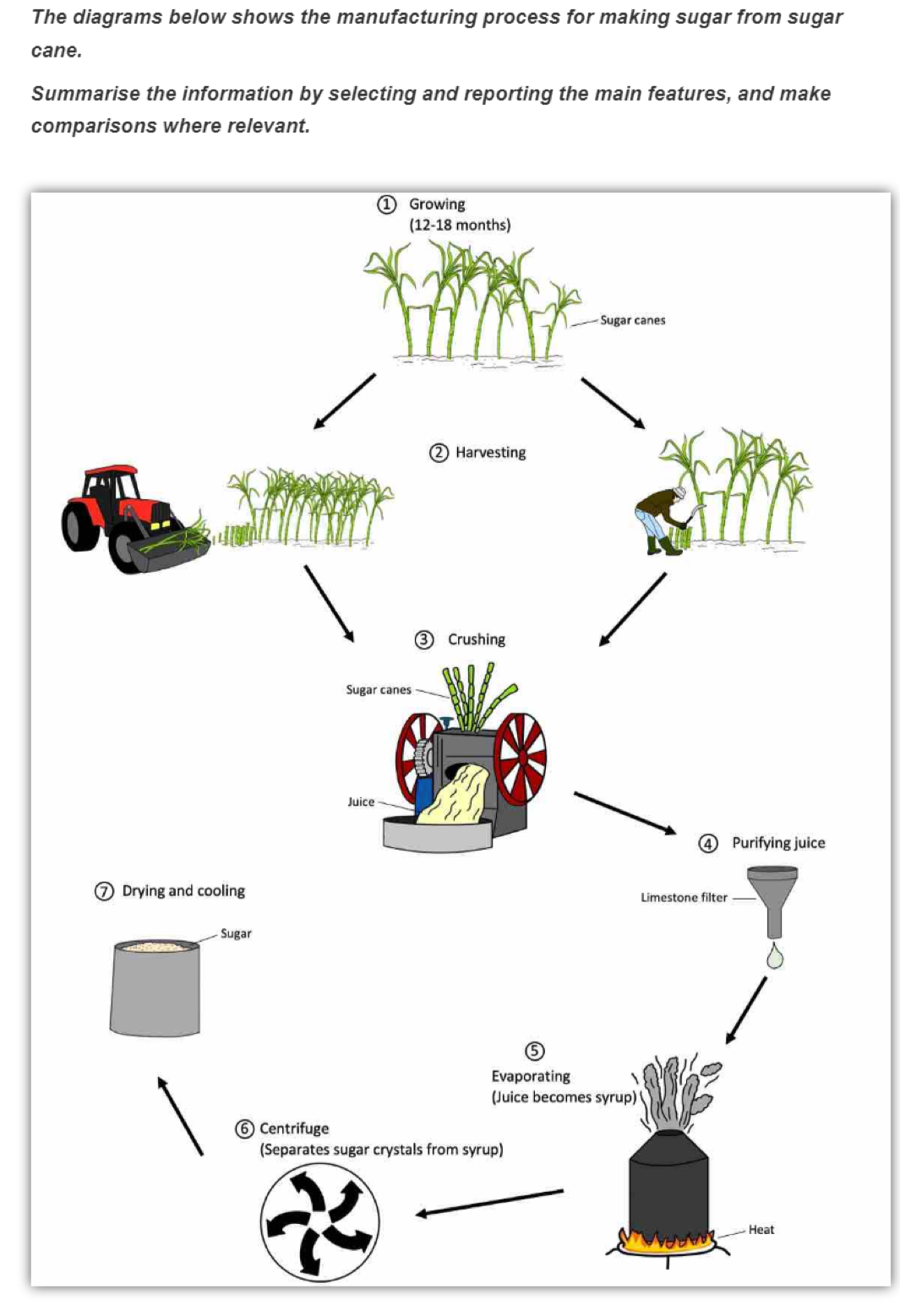
Process task
1 Language used in process tasks
The need to explain movement and physical changes.
ORganize the infor step by step to explain how somethings is done or how st develops.
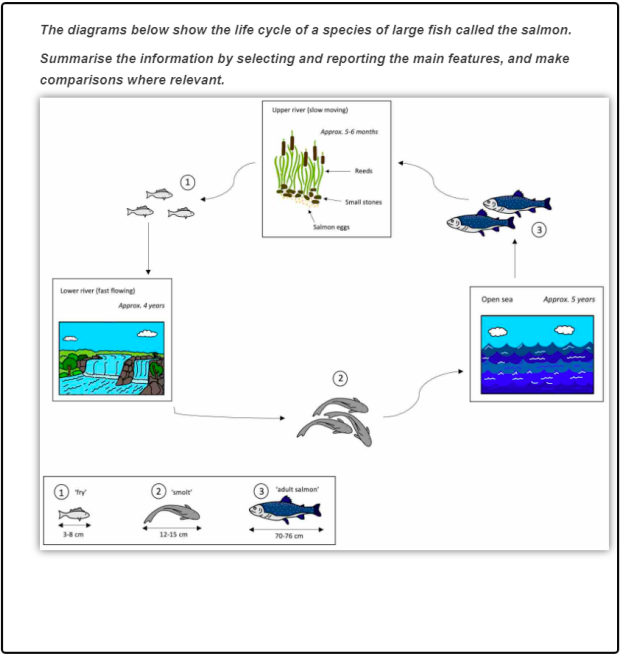
The word ‘fish’ is generally used as an uncountable noun (the plural ‘fishes’ is only used rarely to refer to different fish species). This includes different types of fish such as tuna, salmon, etc. So we can say ‘the tuna swim’, not “the tunas swim”
We can use the word to mean one fish: the salmon swims or several fish: the salmon swim.
NB Whales and dolphins are mammals and are countable nouns.
1.1 Language used in process task
We may need to describe:
time, different stages, physical changes, movement
1.2 Period of time
often saying how long a stage or step in a process takes or lasts, or how much time is spent in a place.
- This stage lasts for four years.
- The fry spend four years in the upper river.
- It took five years to complete the renovations.
With our current task, we cannot say: ‘The salmon eggs take 5-6 months to break out of their eggs’, because we do not know how long this specific process takes and it is unlikely to take up 6 months for the fish to break out of their eggs.
Phase, period, stage, and time are useful synonyms to use here, but be careful with the prepositions at and during. Phase and time can refer to either a length of time or point of time, and so we can use both during and at with these:
- During this phase NOT
at this phase - During this period NOT
at this period - During this stage, at this stage
- During this time, at this time
1.3 Describing physical changes
We can use the following verbs to describe the physical changes that occur in a natural process:
Become, change, develop, grow, turn into
They are used slightly differently
Become is often used with a comparative e.g. ‘become bigger’, or to describe a change: e.g. ‘the smolt becomes an adult salmon’.
Change has a broader meaning and can be used to introduce the idea: e.g. ‘the fish then changes again and becomes …’, or ‘the fish then changes again, growing bigger …’ It can also be used with ‘into’ e.g. ‘the fry changes into a smolt’ NB not changes to a smolt.
Develop and grow can be used with a specific feature: e.g. ‘the egg hatches and the young fish develops / grows fins and a tail’. Or to describe a change: e.g. ‘the smolt develops into / grows into an adult salmon.’
Turn into is a phrasal verb and is similar in meaning to ‘change into’ or ‘become’ e.g. ‘the fry turn into a smolt’
1.4 Some words to be careful with
We can’t use the verb evolve to describe this type of natural change.
Similarly, be careful with the verb transform, which suggests a change into something completely new. For example, a ceterpillar transforms into a butterfly or Following the renovation, the old shed was transformed into a modern restaurant.
Make sure any adjectives or adverbs we use accurately describe what we are shown in the images. Can you see any problems in the following extracts?
The fish grow enormously in size during the final stage.
The huge salmon returns …
The fry migrate downstream to a highly turbulent water
At the end of this period, it turns into gigantic ‘adult salmon’
The fully developed salmon now have unique color patterns on their back…
Make sure the language we use accurately describes the images in the diagram. Pay particular attention to any adjectives and adverbs we use.
1.4.1 Exercises
Question 1
Choose the verbs into correct box.
remain, stay, flow, develop into, spend, grow into, take, last, move, travel, migrate, continue, change, become, leave, transform, turn into
| Time | Movement or lack of movement | Physical changes |
|---|---|---|
| stay | develop into | |
| spend | flow | grow into |
| take | move | change |
| last | travel | become |
| continue | migrate | transform |
| leave | turn into | |
| remain |
Collocation
Some of the verbs in ex 1 can (or must) be used together with an adverb or preposition.
Choose from the following words:
along, at, away from, for, in, into, to, towards
| To last for |
| To continue for |
| To stay away from |
| To flow along / away from / to / towards |
| To remain in/ at |
| To grow into |
| To develop into |
| To turn into |
| To change into |
Correct any errors
- This stage lasts
tofor six month. - The young fish moves away
atfrom the upper river. - The fry changes
tointo a smolt. - The fry spend
fortowardsat least five months here. - The smolt develops
ininto an adult salmon. - The stage continues
infor five to six months. - The fry travels
intoto / towards the lower river. - In the open sea, the smolt develops
tointo an adult salmon. AtDuring this phase, the fish grows much bigger.DuringAt this stage, the fish is only a few centimeters long.
Write any comments or changes would make to following extracts.
- The fish grow enormously in size during the final stage.
- The huge salmon returns …
- The fry migrate downstream to a highly turbulent water.
- At the end of this period, it turns into gigantic ‘adult salmon’
- The fully developed salmon now have unique color patterns on their back …
In sentence 1 - 4, the adverbs or adjectives are too strong. Suggestions:
- The fish grow significantly during the final stage.
- The large fish returns … OR The adult salmon returns … OR The fully grown salmon returns…
- The fry migrate downstream to the faster running water.
- At the end of this period, in turns into a large / fully grown ‘adult salmon’
In sentence 5, we do not know if these patterns are ‘unique’ (other fish may have them and the diagram does not tell us this information) ‘characteristic’ or ‘distinctive’ are good words to use here:
- The fully developed salmon now have distinctive color patterns on their back …
1.5 Numbers and Describing size
In process tasks we are more likely to be using small numbers. The general convention when writing numbers is to use the word form for the numbers one to ten and the numerals for numbers above ten. However, this is not a very important point to remember for the test.
Our writing task gives the following information about the size of the salmon in different stages of its like:
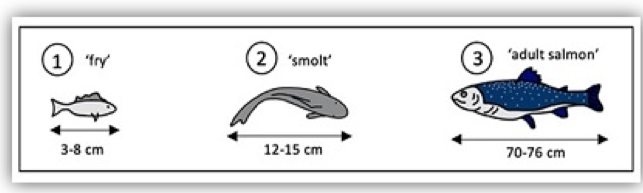
This give us a minimum and maximum length measured in centimeters. We can use the abbreviation ‘cm’ as shown in the image, but using the full word gives a better impression of our writing ability. There are two possible spellings: centimetres and centimeters. Try to be consistent in our spelling. We should often check for a mixture of cm, centimeters, centimetres.
There are several ways to describe the range of sizes above. Look at the following examples (notice the words in blue)
- The fry is between three and eight centimeters long.
- *The fry grows to between three and eight centimeters.
- The fry can grow to between three and eight centimeters in length.
- The fry can reach up to eight centimeters in length.
* We can also say: The fry grows to between three and eight centimeters in length.
Can you correct the errors in the following sentences? Think about the type of relative clause you need to use to add extra information.
- The salmon eggs take approximately 5-6 months to break out of their eggs and develop into baby salmons called ‘fry’, with only 3-8 cm in length. which are …
- The little salmon can grow to more than three centimeters, less than eight in length. -> grow to between 3 and 8 centimeters in length.
- Fry evolve into smolt that is 12-15 centimeters. -> Fry develop into smolt that is 12-15 centimeters in length.
Suggested corections:
- The salmon eggs take approximately 5-6 months to break out of their eggs and develop into baby salmon called ‘fry’, which are only 3-8 cm in length. (NB I used a non-defining relative clause to add the extra information about the length of the fry.)
- The little salmon can grow to between three and eight centimeters in length.
- Fry develop into / change into / turn into smolt, which are 12-15 centimeters in length / long. (Again, I need to use a non-defining relative clause here - notice the comma before which)
2 Coherence and Cohesion
2.0.1 Coherence and cohesion (connecting and organizing ideas)
The first sentence in any paragraph should tell your reader the main topic of the paragraph. The sentences that follow should then expand on the first sentence, adding more information. When this doesn’t happen the result is confusing to the reader and will lower our Coherence and cohesion score. To demonstrate this, look at the following first sentence and think about the questions below:
Firstly, in the upper river, the water moves slowly.
- What does the word ‘Firstly’, tell us? -> that is first step in process,
- As a reader, what do you expect to follow on from this? -> other steps of river
- What information in this sentence do you expect to learn more about?
The word ‘Firstly,’ tells us that this is the first step in the process, and as this is the first sentence in the paragraph, logically, when we read this sentence, we expect to learn more about the water or different parts of the river, like this:
Firstly, in the upper river, the water moves slowly. Then, as the water moves down the river, it flows faster.
But this candidate wrote:
Firstly, in the upper river, the water moves slowly. Salmon eggs are left below reeds and small stones before becoming young salmon called fry.
The information about the water in the upper river in the first sentence is important, but it is not the main idea or topic of the paragraph, and it is not the first step in the process. This is extra information about where the first step takes place (the salmon eggs are left below reeds). A relative clause will help here.
Firstly, salmon eggs are left below reeds and small stones in the upper river, where the water moves slowly.
In the extract in red above, the second step in the process is reduced to ‘before becoming young salmon called fry’. This is too much information to add to our new sentence, so we need to find a way to refer back to the salmon eggs (which is where the young salmon come from):
Firstly, salmon eggs are left below reeds and small stones in the upper river, where the water moves slowly. These eggs then become young salmon and are called ‘fry’.
Think about the information in our sentences following this pattern:
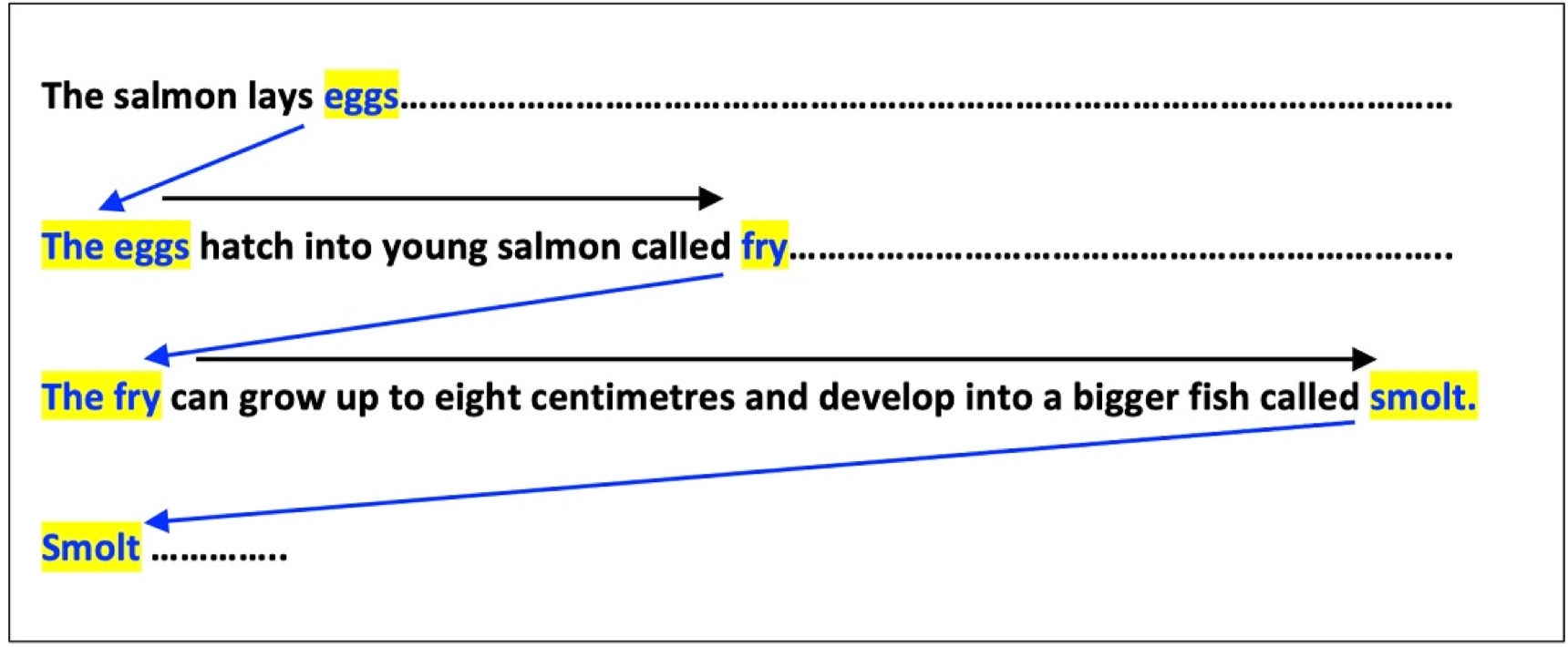
In the above image, we can see that the new information at the end of one sentence becomes the subject or the main idea at the beginning of the next sentence, working in a zig-zag pattern. We can add more information in between these sentences, but the change in focus should be made clear to the reader and we should be able to trace it clearly through our writing.
2.0.2 Exercises
Practice this idea in the following exercises, by putting the sentences in a process summary into the correct order. Then do the same with the words in the sentences.
Question 1
Put the sentences into the correct order by dragging and dropping them into place. Use the referencing clues to help.
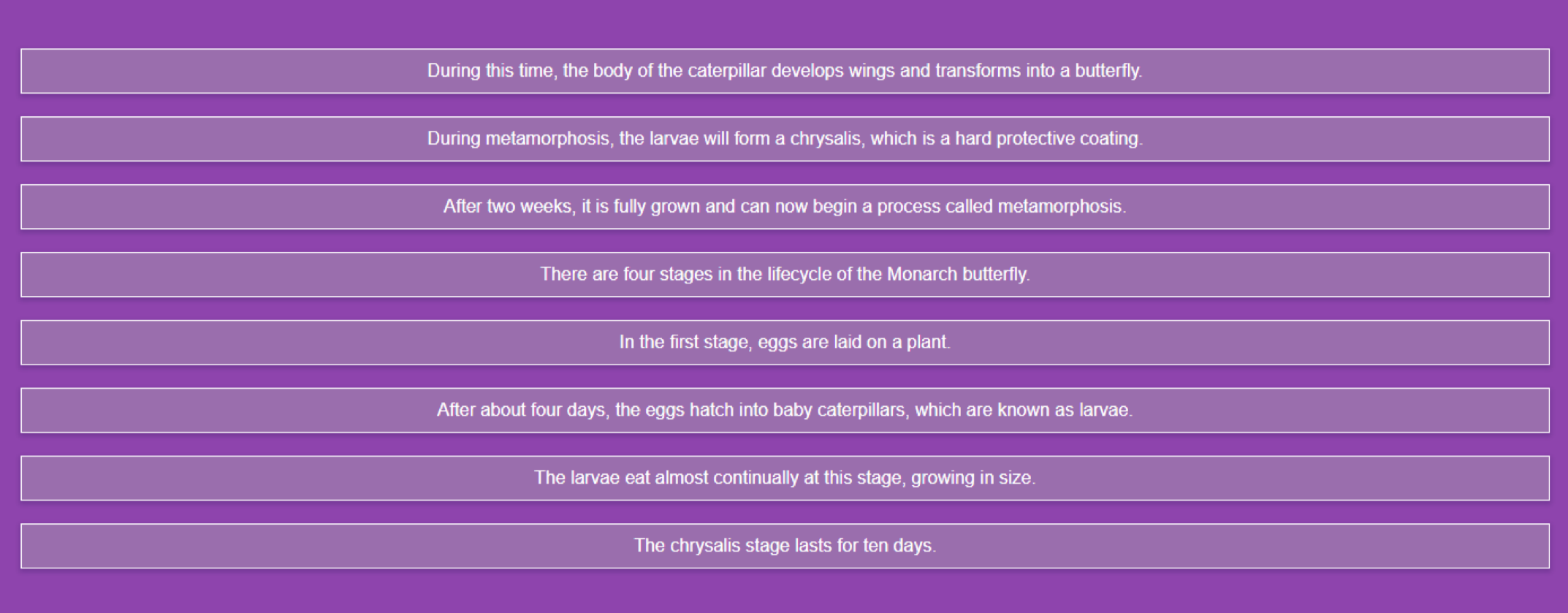
There are four stages in the life cycle of the Monarch butterfly.
In the first stage, eggs are laid on a plant.
After about four days, the eggs hatch into baby caterpillars, which are known as larvae.
The larvae eat almost continually at this stage, growing in size.
After two weeks, it is fully grown and can now begin a process called metamorphosis.
During metamorphosis, the larvae will form a chrysalis, which is a hard protective coating.
The chrysalis stage lasts for ten days.
During this time, the body of the caterpillar develops wings and transforms into a butterfly.
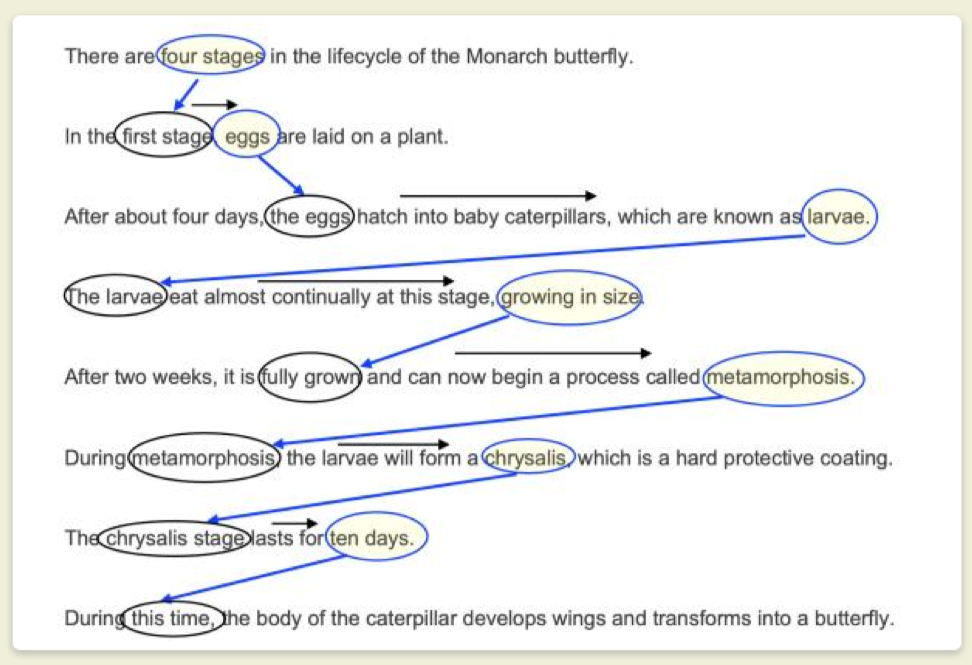
Sentence 1
Correct order

There are four stages in the life cycle of Monarch butterfly.
Sentence 2

In the first stage, eggs are laid on a plant.
Sentence 3

After four days, the eggs hatch into baby caterpillars, which are known as larvae.
Sentence 4
 The larvae will eat almost continually at this stage, growing in size. #### Sentence 5

After two weeks, it is fully grown and can now begin a process called metamorphosis.
Sentence 6

During metamorphosis, the larvae will form a chrysalis, which is a hard protective coating.
Sentence 7

The chrysalis stage lasts for ten day. #### Sentence 8

During this time, the body of the caterpillar develops wings and transforms into a butterfly.
3 Model answer and improving a short answer.
 ## Comments on this task:
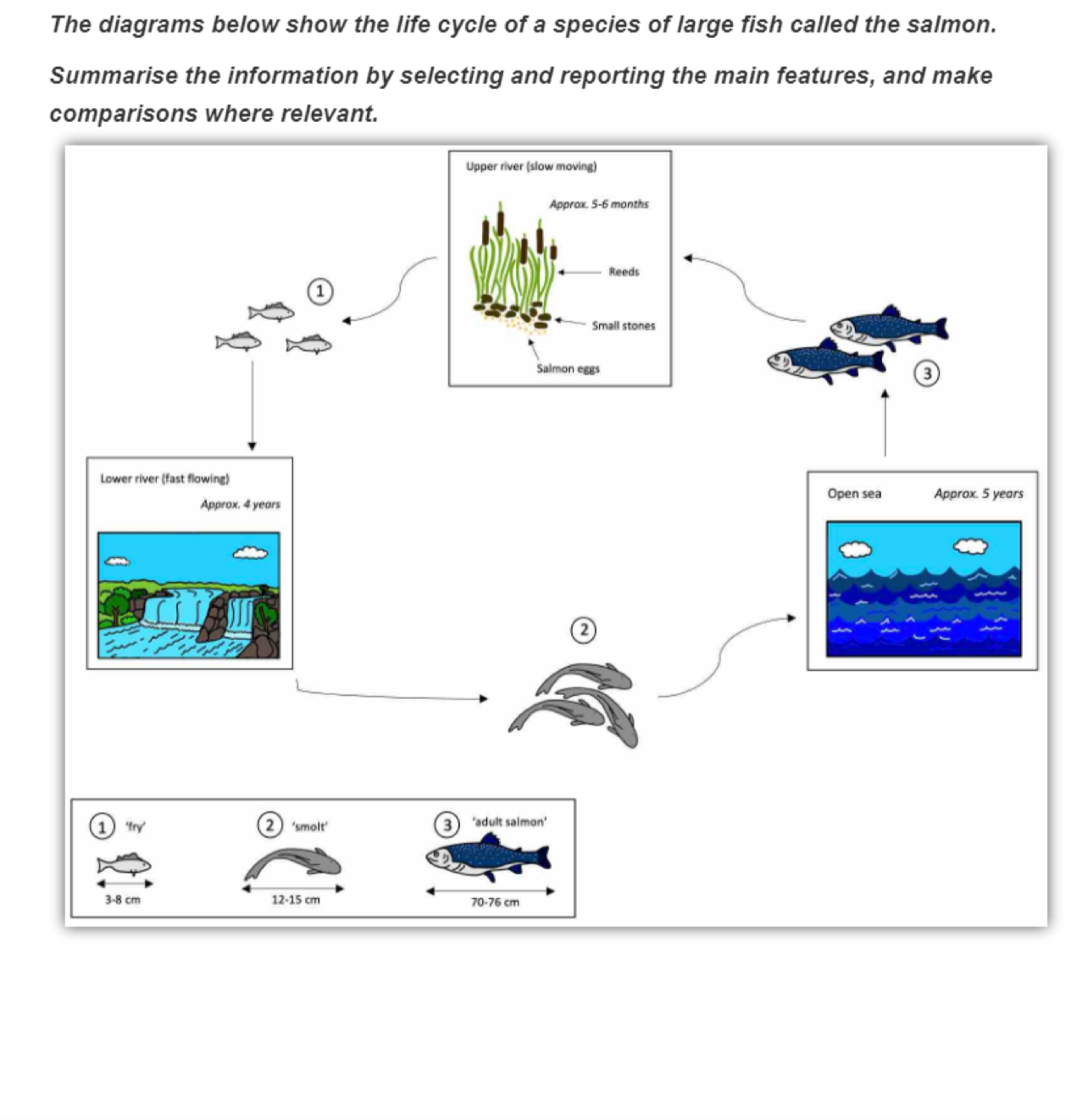
The salmon is a very common type of fish. The question introduces it to us as ‘a species of large fish called the salmon’ to help lower candidates understand the word. We don’t need to introduce it like this in our answer - we would only need to do this with a lesser-known species.
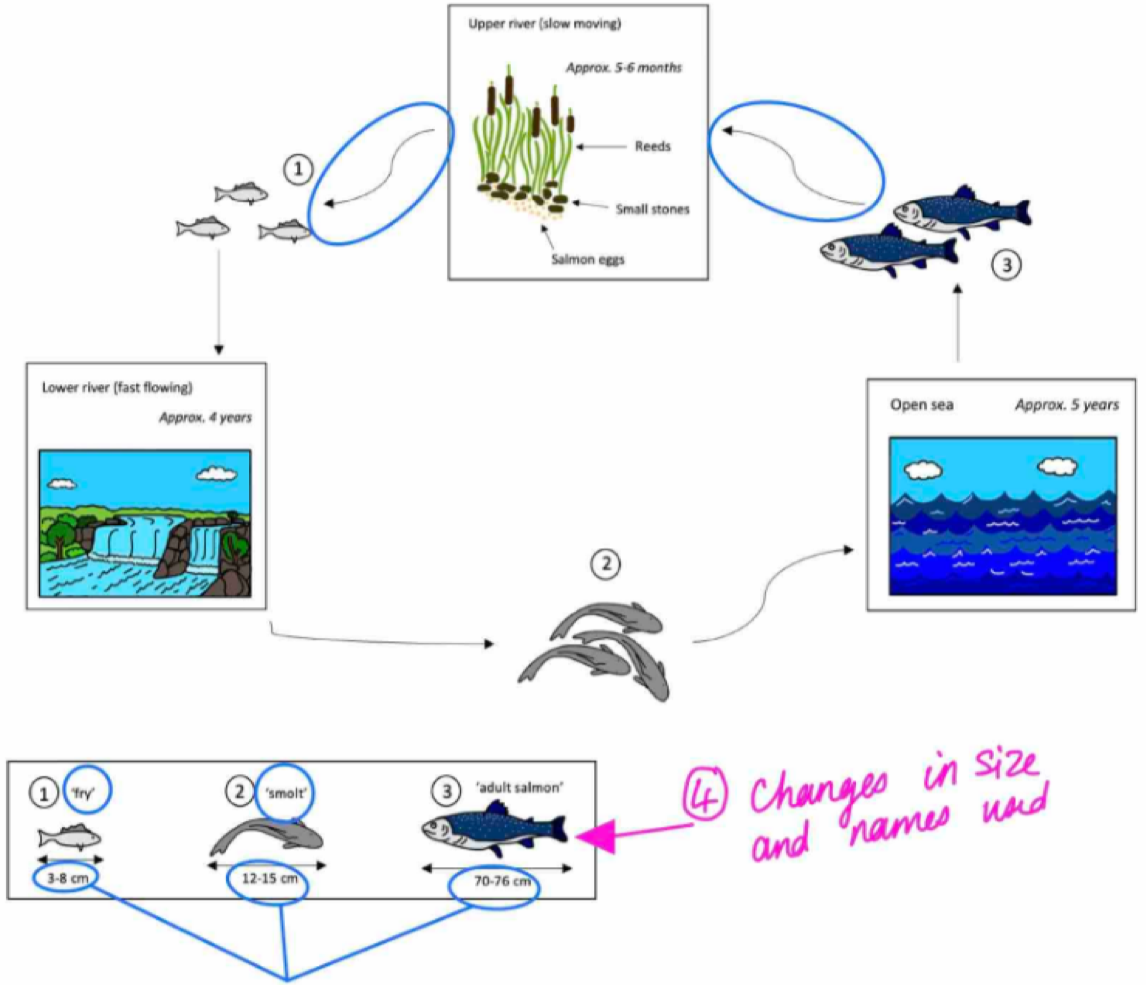
As the diagram shows, salmon live in both the river and the sea.
Look at the other details I noticed in the diagram before writing my answer.
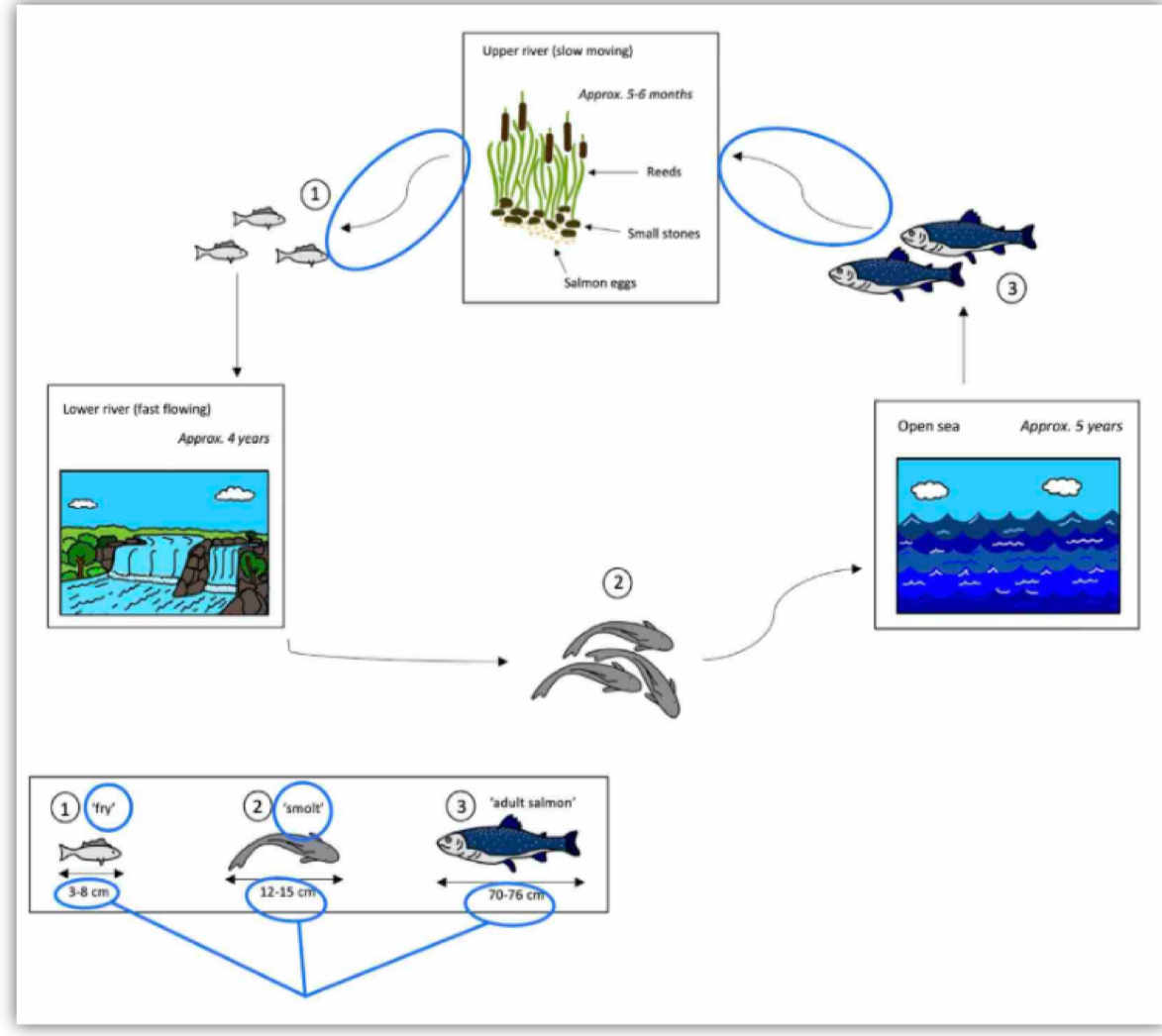
There are several details we need to pay attention to in a diagram like this:
- The arrows - these can be used with different meanings, e.g. to show movement or to show a change. Here they are showing movement between different habitat.
- The key (the extra information in the box) - this tells is the sizes and names of the fish in each stage. Notice that inverted commas have been used for the names. This shows that a word or phrase is being used in an unusual or technically way that may not be commonly known, which can affect how we use these terms in our writing.
- The instruction to make comparisons ‘where relevant’ applies more in process tasks than any other type of task 1 question. We may need to remind ourselves at stage 2 of our planning (when identify key ideas) to see if there is anything we can compare. In this task, we can compare the different environments (faster / slower) and the fish (bigger / longer etc). We might also compare its physical appearance (lighter / darker coloring) or the lengths of time (the first stage is the shortest). However, this instruction may not always be relevant in a process task.
3.1 The overview
Before you complete the exercise, write the overview statement from your answer.
There are three stages in the lifecycle of salmon.
Remember, our overview statement must give the reader a clear (complete) picture of the main features. We make a note of these in the second thinking stage. With a process task, this might include features like: - How many stages there are in the process - overall length of time - where the stages take place
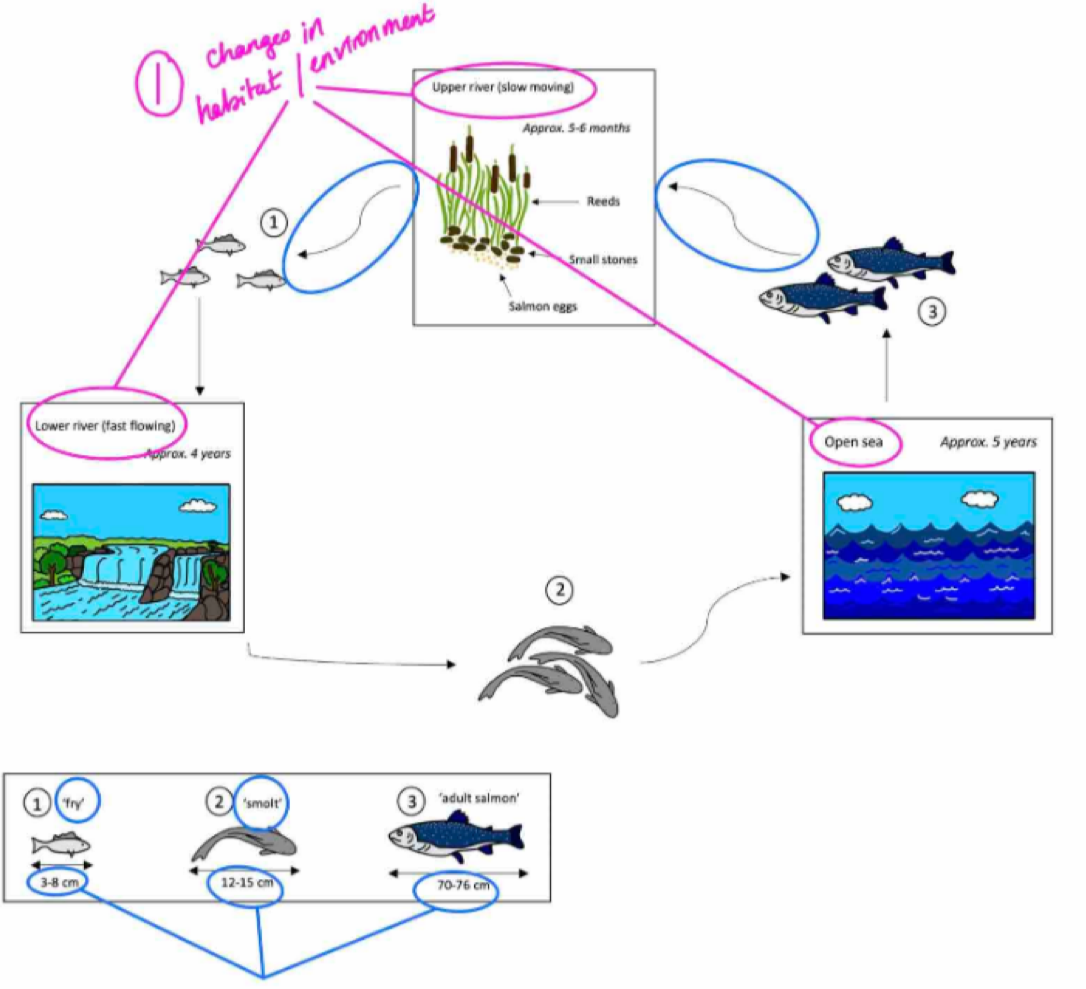
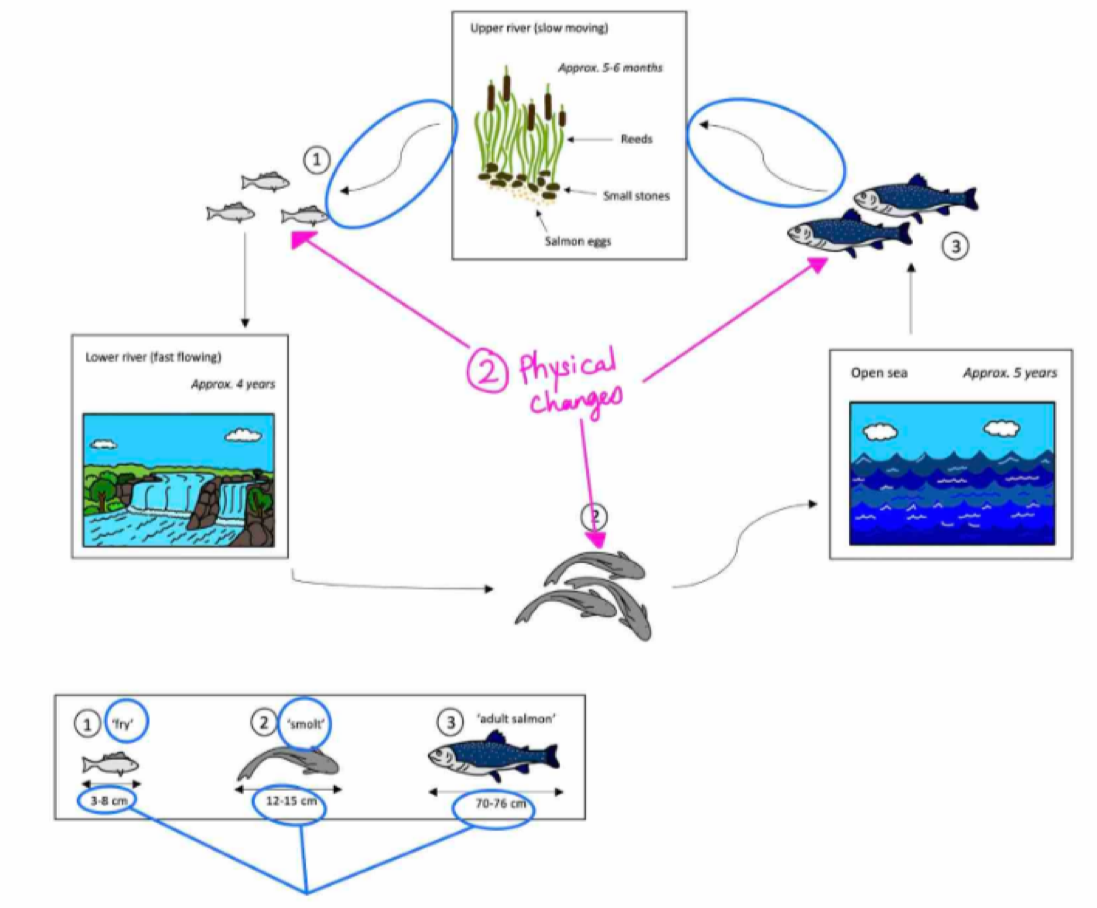
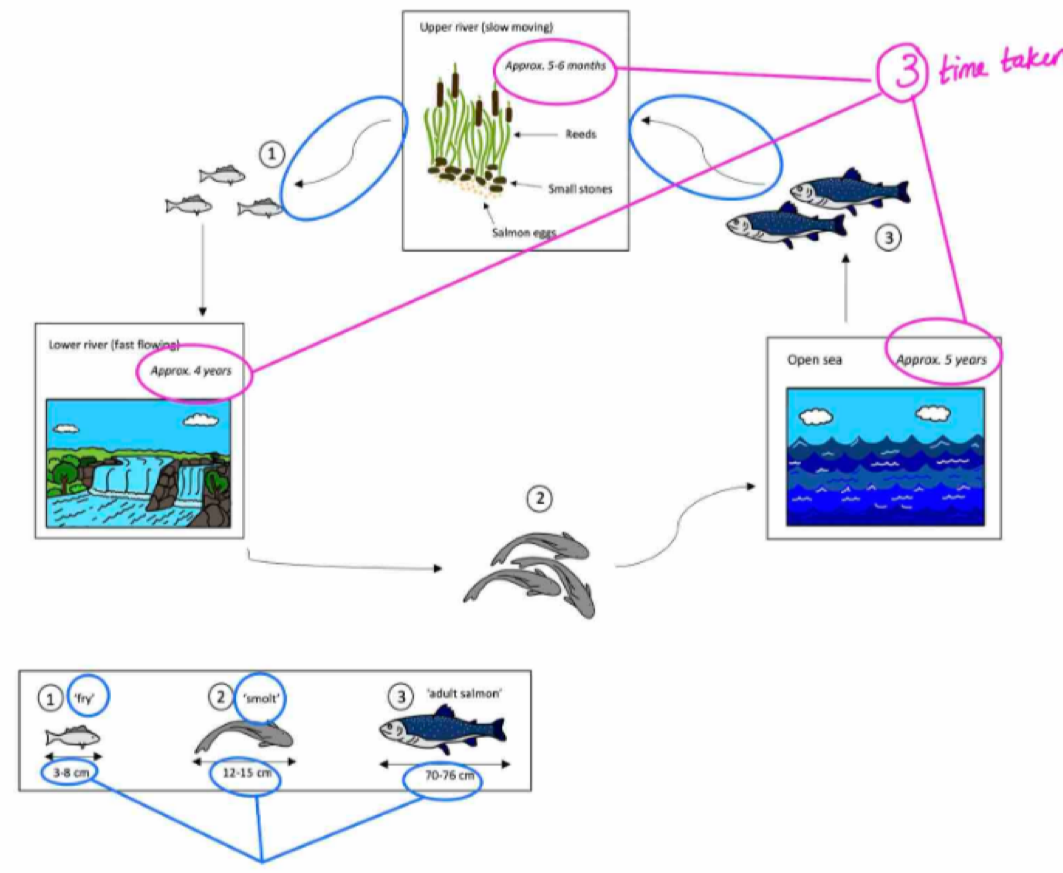
Here are four key features I notice in this diagram
3.1.1 Changes in the habitat / environment
3.1.2 Changes in physical appearance
3.1.3 The time taken at each stage
3.1.4 The changes in size and name
3.1.5 Exercises
Look at the following overview statements and choose the most appropriate comment. You may choose more than one answer for each overview. What change would you make to number 6 to improve it?
| too much detail | not complete | not accurate | ||
|---|---|---|---|---|
| There are three main stages as the salmon develops from egg to mature adult. This kind of fish also experiences three transformations in appearance during the cycle, moving from eggs to fry to smolt and ultimately to adult salmon. | y | y | 1 | |
| Overall, it takes a total of close to 10 years for salmons to develop into its fully mature form. The development process consists of 3 main stages, starting with salmon eggs in the upper river where water flows slowly and ending with the formation of adult salmon. | y | y | 2 | |
| It is clear that they grow enormously in size when reaching adulthood, and also it takes up to ten years for them to return to their birthplace to breed | y | y | 3 | |
| Overall, this natural, 6-staged process happens in three different environments and takes up to 10 years to complete | y | y | 4 | |
| Overall, salmon fish life cycle consists of two main stages, one in the river when it is young and one in the ocean when it comes of age. The link between the two stages is called the estuary stage that starts in the river and goes to the ocean to reach adult life | y | y | 5 | |
| Overall, there are three stages in the life cycle of the large fish | y | 6 |
- There is too much detail here (some information will be repeated later in the answer) and it is not complete (there is no mention of the changes in habitat.)
- There is too much detail here (some …) and it is not complete
- This does not give a clear, complete picture of the changes and suggests the salmon just travels for 10 years.
- This is not a 6-staged process and nothing in this sentence tells us this is about a fish growing and developing.
- There are more than two stages and there is too much detail here.
- We need more information than this e.g. about the changes in habitat.
Sentence 6 could be improved by making the following changes
Overall, there are three stages in the life cycle of the salmon, and each takes place in a different habitat / environment.
A good way to check if our overview statement is too detailed is if it contains specific information we will need to repeat later in our answer.
3.2 Model answer
The diagram shows the different stages in the life cycle of a salmon. Overall, the cycle takes almost ten years and comprises three main stages, each of which takes place in a different aquatic environment.
The salmon begins life as an egg. In the slow-moving waters of the upper river, sheltered by reeds and small stones. Over a period of five to six months, the eggs hatch into very small fish known as ‘fry’, which can grow up to eight centimeters in length. The fry then move to the faster flowing water of the lower river, where they remain for a period of four years and continue to grow. During this phase, they can double or triple in size, reaching 12 to 15 centimeters, and are now referred to as ‘smolt’.
At the end of this stage, the smolt leave the river for the open sea, where they will spend the next five years of their life. It is in this salt-water environment that the fish develops its characteristic shape and coloring and reaches its full length of 70 to 76 centimeters, almost ten times its original size. Finally, the adult salmon will return to the slow-moving river to lay its eggs, and the cycle will begin again.
3.3 Points to notice
- I used inverted commas to introduce the new terms (‘fry’ and ‘smolt’) but only with the first mention of these terms.
- Notice the way that I was able to use different tenses. I used: the simple present, modals (can grow, can double), the passive (are referred to), and future tenses (will spend, will return, will begin). I also varied between the plural (the fry move, the smolt leave) and singular (the fish develops). However, these variations are grouped together logically (i.e. I did not change backwards and forwards between the different tense or between singular and plural).
- In terms of organization, I decided to write about stages one and two in the first paragraph, and then stages three and one (return to the beginning) in the second paragraph.
- My answer is 208 words. There is no ideal length and each task will be different. However, you should aim to write between 160 and 220 words. I have never seen an answer with 150 words that was complete, so I don’t advise you to aim for this length. In the next exercise, you will practise working on a shorter answer
Look back at my model answer and notice how I use the following words and phrases:
to lay an egg
to hatch
to flow
characteristic (adjective)
coloring
its original size
open (the open sea) - we also use this adjective with the word ‘space’, to stress or highkluight that it is not enclosed (e.g. I prefer open space.)
3.4 Coherence and cohesion
Notice that, In my answer, I varied the beginning of my sentences. Compare my version to this - read it aloud to hear the difference
Problem in coherence and cohesion
First, the salmon begins life as an egg, in the slow-moving waters of the upper river, sheltered by reeds and small stones. Next, the eggs hatch into very small fish known as ‘fry’, which can grow up to eight centimeters in length. Then, the fry move to the faster flowing water of the lower river, where they remain for a period of four years as they continue to grow. After this, they can double or triple in size, reaching 12 to 15 centimeters and are referred to as ‘smolt’.
Following this, the smolt leaves the river for the open sea, where it will spend the next five years of its life. Then, the fish develops its characteristic shape and coloring and reaches its full length of 70 to 76 centimeters, almost ten times its original size. Finally, the adult salmon will return to the slow-moving river to lay its eggs, and the cycle will begin again.
3.5 Improving short answers - writing at least 150 words
Process task’s answer can be little too short (below 150 words). Every test question is tested to make sure that there is enough to write about. When practising, be sure to only use authentic materials or those written by experienced test writers (look for the authors mentioned ..)
If we find that our answers are sometimes too short, look back at the diagram and think about the following:
- Are there any key features you have missed?
- Are there any key features you have not highlighted enough?
- Have you made any comparisons?
Also think about the verbs we have used to describe a change - have we been too concise? (For example, although it is accurate to say that ‘The fry become smolt’), this could be developed and expanded to give more information about what is happening at this stage.
Short answers
The diagrams show the process through which a kind of fish called the salmon grows into an adult. The lifecycle of the salmon has 3 main stages and takes place in 3 different locations.
The cycle begins when salmon eggs are laid among the reeds and the small stones of the upper river. After around 5 to 6 months, these eggs turn into fry, which are 3-8 cm in length and begin to move to lower river where water flow is fast.
Fry live there for 4 years and become smolt, measuring 12-15 cm in length, after which they migrate to open sea. They live this new environment for approximately 5 years to become adult salmon (70-76 cm). The adult salmon then begins its journey back to slow-moving upper river where it lays eggs and the process starts over again.
3.5.1 Exercises
Which parts of the answer could the candidate work on to add more? There are also issues with articles and commas here, can you onto the image in the next exercise using the text tool. Then look at my comments and the changes I made.
Look at my notes below and compare them to yours before making the changes
in the next task.
NB in the final paragraph, the writer is saying that the salmon ‘’live there to become adult salmon’’ something is missing here as ‘to become’ is being given as a reason why they live in the sea. Instead, we need to know what changes occur when they live in the sea.
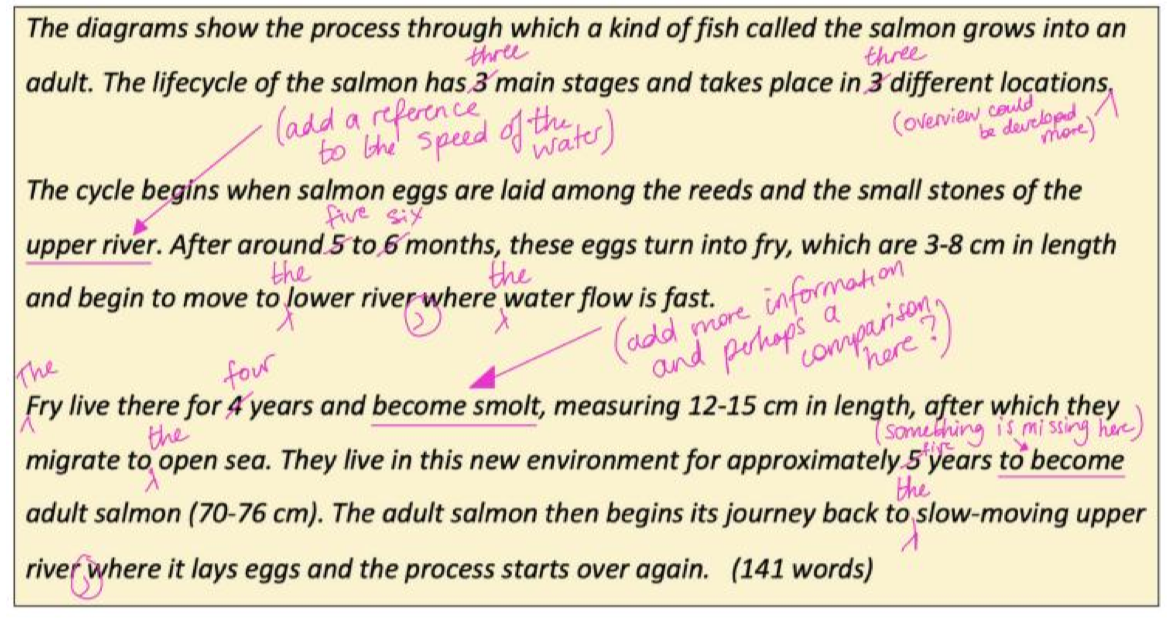
Look at the following four extracts from this answer. Make the suggested longer.
changes in brackets to improve the answer and make
The lifecycle of the salmon has 3 main stages and takes place in 3 different locations. (Can you add more to the overview?)
After around 5 to 6 months, these eggs turn into fry, which are 3-8 cm in length and begin to move to lower river where water flow is fast. (Can you add a reference to the upper river and a comparison?)
Fry live there for 4 years and become smolt, measuring 12-15 cm in length, after which they migrate to open sea. (Add more here and perhaps a comparison about the size?)
They live in this new environment for approximately 5 years to become adult salmon (70-76 cm). (Something information is missing here)
The diagrams show the process through which a kind of fish called the salmon grows into an adult. The lifecycle of the salmon lasts almost ten years and has three main stages, each taking place in a different location.
The cycle begins when salmon eggs are laid among the reeds and the small stones of the upper river. After around five to six months in the slower-moving waters, these eggs turn into fry, which are 3-8 cm in length and begin to move to the lower river, where the water flow is faster.
The fry live there for four years growing bigger and changing into what are called smolt, measuring 12-15 cm in length, after which they migrate to the open sea. They live in this new environment for approximately five years developing into adult salmon and reaching their full size (70-76 cm). The adult salmon then begins its journey back to the slow-moving upper river, where it lays eggs and the process starts over again.
3.5.2 Points to notice
- the new version is now 167 words and so is a good length for the task.
- The overview is now more complete and includes information about the total time taken as well as the different environments.
- Although I changed the smaller numbers to words, I decide to leave the shortest measurements as numerals so that all of the measurements are consistent.
- This writer chose not to use any inverted commas around the names, which is fine.
3.6 Extra practice
Look back at any process task answers you have written in the past and consider your overview statement. Did you include features such as:
how many stages there are in the process overall length of time where the stages take place?
Look at the length of your answers - do they tend to be short? (under or very close to 150 words)? Look back at the diagrams and check the following: Did you use an authentic task (from Cambridge books 9 - 16)? If not, there may not be enough to write about, which is why your answer is too short. Were you too brief in some parts of the summary? Which parts could you expand more?
Remember to think about the following:
Are there any key features you have missed?
Are there any key features you have not have highlighted enough? Have you made any comparisons?
Coherence
and cohesion
Check the coherence and cohesion of your process task answers. Reading the answers aloud can help. Do you vary the beginning of your sentences, or do they always / mainly begin like this:
First, …Then, …. Next, …. After this, …..Following this, ……
Finally,…..
Can you trace the ideas in your summary using the zig-zag pattern we saw in the Monarch butterfly summary? What changes can you make now to improve the coherence and cohesion?
Language Did you manage to vary the tenses in your answer? What changes could you make? Is there any new language you would like to make a note of to use in the future?
3.7 Homework
To prepare for the next lesson, write an answer for the following writing task question.