Listening practice - mistake log IELTS Practice Set 14 listening test 2
1 Cambridge IELTS 14 - listening test 2
- Date: 22/07/2025
- Total Score: 30/40
2 Performance Summary
| Category | ✅ Correct | ❌ Incorrect | ⏳ Skipped | 🎯 Accuracy |
|---|---|---|---|---|
| [Topic] Environment | 4 | 6 | 0 | 40.00% |
| [Topic] Science & Technology | 4 | 6 | 0 | 40.00% |
| [Listening] Matching | 6 | 0 | 0 | 100.00% |
| [Listening] Note/Form Completion | 13 | 7 | 0 | 65.00% |
| [Listening] Map/Plan/Diagram | 4 | 1 | 0 | 80.00% |
| [Listening] Multiple Choice | 7 | 2 | 0 | 77.78% |
| [Theme] Listening to a Tour Guide | 8 | 2 | 0 | 80.00% |
| [Theme] Giving Tutorial Present. | 9 | 1 | 0 | 90.00% |
| [Theme] Reporting a Problem | 9 | 1 | 0 | 90.00% |
3 Recording 1
| Question | My answer | Corrected | ISSUE |
|---|---|---|---|
| 8 | SWIMMING | RUNNING | Caught the first sport mentioned (“swimming”) and wrote it down too quickly. |
JULIE: And do you do any other types of exercise?
CARL: Yeah, I sometimes do a little swimming, but usually just when I’m on vacation. But normally I go running a few times a week, maybe three or four times.
3.0.1 Keyword in the Question:
“… goes regularly…”
“Sometimes” and “just when I’m on vacation” = NOT REGULAR ⇒ ❌ swimming
“Go running a few times a week, maybe three or four times” = ✅ regular ⇒ running
You may have caught the first sport mentioned (“swimming”) and wrote it down too quickly.
This is a common trap in IELTS Listening – they give a distractor (swimming) before the real answer (running).
It tests your ability to listen for the full context and understand frequency words like “sometimes” vs “regularly”.
Always listen until the speaker finishes their full idea.
Be careful with contrast words like:
➤ but, however, actually, normally, usuallyPractice listening for frequency adverbs (always, often, sometimes, rarely, etc.).
4 Recording 2
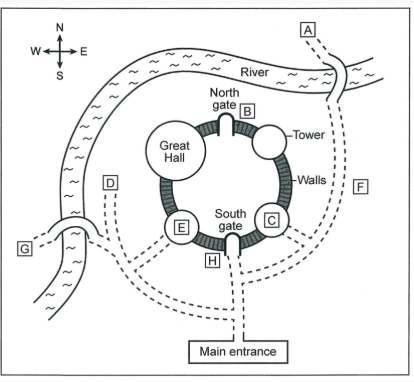
| Question | My answer | Corrected | ISSUE |
|---|---|---|---|
| 11 | C - a fire damaged part of the main hall | B - a new building was constructed for her | Miss the time reference |
| 17 | G | E | hear ‘past’ and think it is go through the bridge and choose wrong answer. |
Q11: Before Queen Elizabeth I visited the castle in 1576,
A. repairs were carried out to the quest rooms.
B. a new building was constructed for her.
C. a fire damaged part of the main hall.
transcript:
“…it was beginning to look a bit run down, and it was decided that rather than repair the guest rooms, they’d make a new house for her out of wood next to the main hall.”
“…She stayed there for four nights… unfortunately it was destroyed a few years later by fire.”
The fire happened after her visit, not before
The option talks about timing, and IELTS tests this detail often.
“…they’d make a new house for her …” clearly matches “a new building was constructed for her_”.
- “before”, “after”, “by the time”, “later”, etc They are critical in eliminating distractors like C here.
Q17: Bow and arrow display - where is it?
My confusion: I thought “past” = “across the bridge”, but that’s a common listening trap.
Transcript:
“…take the first left after the main entrance and follow the path past the bridge, then you’ll see it in front of you at the end.”
Why mistake happens:
“past the bridge” = go along the path and pass by the bridge.
It does not mean cross the bridge.
Words like past, next to, near, and beyond are visual direction words.
Always pause to ask:
🔹 “Is the speaker saying go over the bridge or just go past it?”
4.0.1 Words that Usually mean “GO OVER the Bridge”
| Phrase | Meaning |
|---|---|
| Cross the bridge | Walk/go over the bridge to the other side |
| Go over the bridge | Same — you’re physically crossing it |
| Walk across the bridge | Same as above |
| Head to the other side of the bridge | Move across it completely |
| Continue across the bridge | Emphasizes completing the crossing |
| Take the bridge | Implies using it to go to the other side |
| Follow the path over the bridge | Path includes crossing the bridge |
Examples:
“Go over the bridge and you’ll see the stage on your right.”
“Continue across the bridge and turn left at the gate.” ### Words That Mean “Go PAST the Bridge” (but do NOT cross it)
| Phrase | Meaning |
|---|---|
| Go past the bridge | Walk near it, but stay on the same side |
| Walk alongside the bridge | Stay next to it, not crossing |
| Follow the path past the bridge | Continue in the same direction without crossing |
| Go down the path beyond the bridge | Keep going, but still don’t cross |
| Before the bridge / Just past the bridge | Still on the same side, near it |
| Next to the bridge | Located beside, not over it |
Examples:
“Follow the path past the bridge and you’ll see the café at the end.”
“Don’t go over the bridge — the museum is just beside it.”
They may say both in the same sentence:
“Take the first left, follow the path past the bridge, and then go over the small footbridge on your right.”
✅ So always slow down when you hear bridge, and listen for clues:
“over”, “across”, “cross” → ❗Cross the bridge
“past”, “beside”, “along” → 🚫 Do NOT cross
5 Recording 3
| Question | My answer | Corrected | ISSUE |
|---|---|---|---|
| 23 | B. spread from the island to other areas | A. became isolated on the island. | Choose the answer too soon. (miss) |
other animals like bears were able to roam around the whole area.I think it mean speard, (oh not, the answer is ‘spread from the island to other areas’.
“…St Paul’s Island wasn’t an island, it was connected to the mainland…
…the climate warmed up and the sea level began to rise, and the island got cut off from the mainland.
So those mammoths on the island couldn’t escape; they had to stay on the island.”
🟢 That’s a clear definition of becoming isolated.
You chose:
B. Spread from the island to other areas.
🔻 But the script says:
“…they had to stay on the island.”
They were trapped, not spreading.
5.0.1 Paraphrased meaning in this example
| Transcript Phrase | Paraphrased in Option |
|---|---|
| “…got cut off” | “became isolated” ✅ |
| “had to stay” | “became isolated” ✅ |
| “couldn’t escape” | “became isolated” ✅ |
5.1 Vocabulary & Phrases from this Transcript
| Phrase | Meaning |
|---|---|
| climate warmed up | climate change began |
| sea level began to rise | result of warming |
| got cut off | became separated |
| couldn’t escape | became trapped |
| roam around | move freely |
| extinct | no longer exist |
| prehistoric extinction | species death in ancient times |
| animated diagram | moving visual explanation |
| chronological pattern | arranged by time order |
| overrun (time) | exceed the time limit |
6 Recording 4
| Q# | Correct Answer | Your Answer | Mistake Type | Why It Was Marked Wrong |
|---|---|---|---|---|
| 31 | dances | dancing | Form | You used the -ing form. But only noun (plural) is accepted here. |
| 32 | survival | survive | Word form | “Survive” is a verb. The sentence needs a noun: “ensure their survival.” |
| 35 | comets | cosmic | Wrong word | You guessed a related word, but the speaker said “comets” (a type of celestial object). |
| 37 | instruments | instrument | Singular/plural | The plural “instruments” is correct as it refers to multiple inventions. |
| 38 | thermometer | demometer | Spelling | Likely a hearing/spelling error. “Demometer” is not a word. |
| 39 | storms | storm | Singular/plural | The sentence uses “storms” in general. Plural is needed. |
| Word/Phrase | Meaning |
|---|---|
| weather gods | deities believed to control weather |
| rites / dances | traditional ceremonies for worship or belief |
| survival | continuing to live or exist |
| phenomena | observable facts or events |
| halo / haloes | rings of light around sun/moon |
| comets | icy space objects with tails |
| proverbs | traditional sayings that express truth |
| instruments | tools used for measuring (e.g., barometer) |
| thermometer | tool to measure temperature |
| barometer | tool to measure air pressure |
| storms | severe weather events (rain, thunder) |
| telegraph | device for sending messages electronically |
6.0.1 Always check grammatical form:
Look before and after the gap.
If the sentence says:
“to ensure their ___”
You know it requires a noun.
6.0.2 Train yourself to recognize plural forms:
Words like:
- storms, festivals, dances, instruments
are often required in general statements.
6.0.3 Spelling matters!
You can lose marks even with small spelling mistakes. Practice dictation and listen to endings like:
/s/ for plurals
/əd/ or /t/ past participles
Watch for soft vs. hard c and t sounds.
7 Vocabulary and phrases list
7.1 Recording 1
| Useful Vocabulary | Synonyms or Natural Alternatives |
|---|---|
| Theft | Robbery, stealing, burglary |
| Report a theft | File a report, make a report |
| Quite a bit of cash | A large amount of money, considerable money |
| Realised I’d been robbed | Discovered I was a victim of theft |
| Group of young boys | A bunch of kids, several boys |
| Asking the time | Pretending to need the time, distraction tactic |
| Didn’t take the keys | Thankfully, the keys were still there |
| A week old phone | Recently purchased phone |
| 💬 Common IELTS Expressions | 💡 Function / Usage |
|---|---|
| “I’m here for two months.” | Stating duration |
| “I come over most summers on business.” | Habitual action (present simple for repeated past) |
| “I’ve had a really good trip this year.” | Present perfect for life experience |
| “I had my backpack on.” | Past simple for sequence of actions |
| “At first I thought…” | Describing sequence of realization |
| “That’s when I realized…” | Transition marker for realization |
| “Fortunately, I don’t keep my credit cards…” | Linking word to express relief |
| “Anyway…” | Transitioning between ideas |
| “Can you remember anything about them?” | Common question structure |
7.2 Recording 2
7.2.1 Workplace & Apprenticeship
apprenticeship
human resources manager
supervisor / mentor
departments
company policy
probationary period
statutory public holidays
overtime
personal circumstances
eligible for flexible working
“take in new information”
“don’t worry too much”
“make the most of that opportunity”
“make an effort to talk to…”
“helping you to identify areas for improvement”
“meet with them on a weekly basis”
“you’re here to learn”
“run through a few company policies”
7.2.2 Everyday English for Office Communication
“don’t use it for personal use”
“speak to your supervisor”
“don’t assume you’ll automatically be permitted”
“we understand that people do have commitments”
“as long as they’re practical”
7.2.3 PART 1/2 – Possible Questions to Practice
Q: Describe a company or organisation you know.
- Use vocabulary: “departments,” “supervisor,” “casual clothes policy,” “overtime”
Q: Describe a rule in your school or workplace you agree or disagree with.
- Use: “don’t use the internet for personal use,” “no packed lunch policy,” “overtime is not required but recommended”
Q: Describe a mentor or a person who guided you.
- “My mentor supported me weekly and helped me set goals and identify areas for improvement…” ### Grammar Structures
| Grammar / Function | Example from Script |
|---|---|
| Imperatives (for advice/instruction) | “Check with someone”, “Talk to people”, “Don’t use it for personal use” |
| Future Simple (policy, plans) | “You’ll be expected to work a 40-hour week.” |
| Conditional | “If you’re not sure what to do…” / “If this is a problem…” |
| Modals for advice/possibility | “You should make the most of the opportunity.” / “You can also discuss…” |
| Relative clauses | “…someone who’s recently completed an apprenticeship.” |
7.3 Recording 3
7.3.1 Urban Planning & Geography
urban planning
coastal cities
river estuary
wetlands
coastal erosion
inland
downstream
sea level
drainage channels
ecosystem
flood prevention
global warming
waste disposal
international cooperation
7.3.2 Speaking/Presentation Vocabulary
“presentation structure”
“general historical background”
“case study”
“geographical factors”
“maps of different cities”
“slides everyone can see”
“audience involvement”
“past mistakes”
“current action”
“future risks”
“international implications”
7.3.3 Useful Academic Verbs
establish (e.g. why coastal cities were established)
expand (e.g. as the city expands)
discharge (e.g. pollutants are discharged)
protect against (e.g. protect against flooding)
replace (e.g. replace the drainage channels)
deal with (e.g. deal with the problems)
act together
abide by (e.g. abide by environmental principles)
7.3.4 Collocations / Natural Phrases
| Phrase | Context |
|---|---|
| “talk about the structure of your presentation” | IELTS Speaking Part 3 |
| “get stuck in anyway” | Informal, shows determination (Reading) |
| “sounds sensible” | Reacting to an idea (Speaking Part 3) |
| “they built the drainage channels too close to sea level” | Cause & effect – useful in Task 1 & 2 |
| “protect against flooding” | Common environmental collocation |
| “work together to some extent” | Useful for balanced argument writing |
| “a long time before countries come to a decision” | For Task 2 disagreement or delay topics |
7.3.5 Grammar & Structure
| Structure | Example |
|---|---|
| Passive voice | “were actually built by the sea”; “channels were built” |
| Conditional (Type 2) | “If there’s a lot of rain, the water can’t run away” |
| Modals | “They should be able to work together”; “We could ask people” |
| Cause and effect | “It means more pollutants are discharged” |
| Contrast | “That won’t help with flood prevention now, will it?” |
| Cleft structure | “What they didn’t take into account was global warming” |
7.3.6 IELTS SPEAKING IDEAS
PART 2: Describe a City You Know
Use:
“It’s a coastal city built where a river meets the sea.”
“It has drainage channels, but due to rising sea levels, flooding is now a real concern.”
PART 3: Environment & Urban Development
Q: What are the biggest challenges cities face today?
→ “One major issue coastal cities face is climate-related flooding. Many were built near sea level, and older infrastructure like drainage channels are now ineffective.”
Q: Should countries work together to tackle environmental issues?
→ “Absolutely. Cities can’t deal with these problems in isolation — international collaboration is key.”
7.3.7 IELTS WRITING TASK 2 CONNECTIONS
Example Prompt:
Some people believe that governments should spend money on protecting cities from climate change. Others think they should focus on economic development. Discuss both views and give your own opinion.
Use points from the transcript:
Coastal cities suffer from drainage/flooding issues.
Long-term solutions require international cooperation.
Balancing infrastructure upgrades vs. investment in economy ## Recording 4
7.3.8 Topic specific
| Word/Phrase | Meaning / Use |
|---|---|
| renewable sources | sustainable energy like sun, wind, water |
| harness the movement | use or control energy |
| generate electricity | produce power |
| erratic | irregular or unpredictable |
| sediment | small particles like sand or soil |
| environmental problems | issues harming nature |
| tidal lagoon | man-made area to control tides for energy |
| breakwater | structure to protect shore or lagoon |
| greenhouse gas emissions | pollution causing climate change |
| relatively cheap | low in cost compared to others |
| boost to the local economy | increase jobs and growth in the area |
| migration patterns | natural movement of birds/fish |
| build-up of silt | accumulation of sediment in water |
| ecosystems | interdependent life systems in nature |
7.3.9 Academic Verbs
derive energy from…
construct a lagoon
activate turbines
create components
disturb migration patterns
affect ecosystems
estimate job creation
7.3.10 IELTS WRITING & SPEAKING STRUCTURES
🔸 Cause & Effect
“Burning fossil fuels damages the environment and they’ll eventually run out.”
“This leads to environmental problems.”
“Rising tides mean the lagoon produces electricity multiple times a day.”
🔸 Contrast / Comparison
“Unlike solar and wind energy, tidal energy doesn’t depend on the weather.”
“The source is constant, but the waves are erratic.”
🔸 Data / Facts (great for Task 1 and Speaking Part 3)
“Two high tides a day → electricity generated 4 times daily”
“Enough for over 150,000 homes”
“More than 2,000 jobs created”
7.3.11 IELTS LISTENING SKILLS IMPROVED
| Skill | Example |
|---|---|
| Understanding technical terms | breakwater, hydro turbines, lagoon |
| Following complex descriptions | step-by-step process of water movement in tidal lagoon |
| Recognizing paraphrasing | “cause environmental problems” = “disturb migration”, “build-up of silt” |
| Spotting numbers & figures | “5 meters”, “14 hours per day”, “2,000 jobs”, “150,000 homes” |
7.4 IELTS WRITING TASK 2 (Possible Use)
Question Example:
Some people believe that alternative energy sources should replace fossil fuels completely. To what extent do you agree?
Use in Argument:
“Marine renewable energy like wave and tidal energy is constant and reliable.”
“Unlike fossil fuels, they produce no greenhouse gases.”
“Although some may disturb wildlife, careful planning can minimize harm.”
8 Speaking
9 Writing
9.1 🎧 Effective Listening Practice Process (Full-Skill Integration)
9.1.1 ✅ 1. Take 2 Listening Tests per Week (Full 40 Questions)
Simulate real exam conditions (headphones, timing).
Use Cambridge IELTS books 10–18 for authentic practice.
After finishing, log your mistakes, and do a deep error analysis.
9.1.2 📝 2. Error Log Analysis System
For every mistake (even close ones), record:
| Type | Question | Wrong Answer | Correct Answer | Why You Missed It | Vocabulary/Structure |
|---|
This helps improve:
Vocabulary
Grammar
Distractor recognition (very important)
Paraphrasing skills for Reading and Writing
9.2 🔄 3. Shadowing & Dictation (Listening → Speaking & Writing)
Do this with 1 test per week (after checking answers).
9.2.1 Step-by-step:
Dictation – write down the full recording transcript for 1 section.
Underline synonyms/paraphrased phrases.
Shadow (repeat aloud with same intonation and rhythm).
Summarize the section in your own words.
Record yourself and evaluate fluency & coherence (like Speaking Part 3).
✅ This improves:
Listening accuracy
Speaking fluency
Lexical resource & complex sentence structure (Writing & Speaking)
9.3 📚 4. Create Vocabulary Banks from Listening
Each test contains academic + conversational vocabulary. Create a table:
| Word/Phrase | Meaning | Example from Listening | My Own Sentence |
|---|---|---|---|
| Subsidised | Supported financially | “A heavily subsidised canteen” | My workplace provides subsidised meals. |
✅ Apply these to Writing & Speaking tasks.
9.4 💬 5. Write & Speak from Listening Topics
Take themes from Listening (e.g. environment, education, employment):
Write a Task 2 essay on a related question.
Practice a Speaking Part 2 & 3 answer on the same topic.
This builds content cohesion between skills, which is how top scorers learn faster.