Explaining and Clarifying ideas
1 Explaining an idea - when and how
As part of our argument, we may need to give an explanation. We can do this to explain the meaning of a key term, explain the context for our ideas, or explain a complex idea in a simpler way. A question we are often asked is, ‘How do I know when I need to explain an idea?’.
We wrote about the topic of homelessness, and the issues surrounding this topic are generally the same in many parts of the world. However, with other topics, this is often not the case, which is why our ideas sometimes need to be explained further. For example, when writing about eating healthy, one person might make the following argument.
It is important to eat fruit every day, because it contains vitamins that help keep us healthy. Therefore, I completely agree with the idea that schools should encourage all children to eat fruit.
However, someone with an intolerance to fruit, who gets a severe stomach ache and skin problems after eating it, may write:
Eating fruit makes people feel unwell, and it even affects their ability to work. Therefore, I completely disagree with the idea that schools should encourage all children to eat fruit.
Anyone without the same intolerance is likely to be confused by the first statement in this argument. Again, language plays a key part: this is not a fact that is generally true for everyone, yet the use of the simple present suggests that it is. Using modal verbs (may, can, etc), as well as words and phrases like ‘sometimes’, ‘for some people’, helps to clarify ideas like this. For example:
Eating fruit can make some people feel unwell, and it can even affect their ability to work. Therefore, I completely disagree with the idea that schools should encourage all children to eat fruit.
In this version, the writer has presented a fact that logically supports their argument, and helps the reader understand why they hold this position.
Our test question will sometimes do this too:
There are now millions of cars on the road in most big cities. Pollution from cars is the most important problem that big cities face today.
To what extent do you agree or disagree?
The first sentence in this writing task presents a fact to support the argument being made in the second sentence - that this type of pollution is ‘the most important’ problem that big cities face.
1.1 Fact and opinion
A fact is something that can be objectively measured and verified, while an argument or opinion cannot. In the test question, we know that the first sentence is a fact because we can verify it by counting the number of cars on the roads. We cannot verify the second statement because it is an opinion; we can only discuss it, and decide whether it is a valid argument or not. This is what our essay must do, which helps to explain why there is no right or wrong answer in task 2.
KEY IDEA: In writing task 2, you will be presented with an argument that you must discuss and respond to, there is no right or wrong answer. The question will sometimes include a fact that supports the argument being made. You do not need to discuss this fact, but you should not ignore it - it is there to make the context for your essay clear.
2 Perspective
It is important to be aware when we are writing about things that are universally, or generally true, and when we are writing about things that are only true for us. This matters for bigger ideas too - our city will not necessarily look the same as my city, and it will not operate by the same rules, which are based on our culture and history. Thus, our ideas on city living, and life in general, will reflect our own background and experiences, and when we are writing, we need to help the reader see these issues from our viewpoint. Perspective matters.
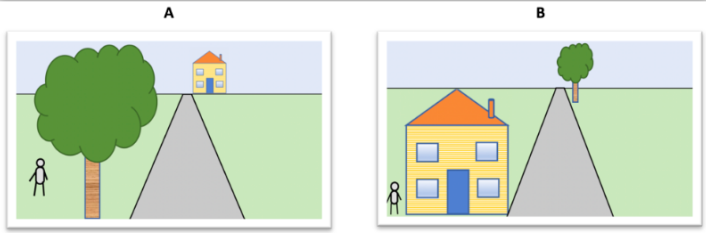
To the person in these images, the tree and the house appear large or small, and easy to see or difficult to see, depending on where they are standing, and what is happening around them. This neatly illustrates the meaning of the terms viewpoint, point of view, and position. Thus, a rich person, who has always lived in a luxurious penthouse, will not have the same perspective on city life as a homeless person living in the same city. Similarly, someone with severe food allergies will not see the topic of food and diet in the same way as a person without these problems.
If we live in a city where the justice system is unfair, this will inevitably affect our opinions about this topic, so we need to explain the context for our argument when discussing this issue. If we are writing about traffic problems, and we live in a very busy city like Ho Chi Minh city, we need to help the examiner to see the problem as we see it - from our perspective. We can do this by explaining the context for our dieas
Crime and punishment are extremely emotive issues in my country, where …
The traffic in my city is …, so …
2.1 Language note
In academic writing, or when writing about a serious issue, we often begin by defining key terms. This can help to explain the context for the ideas in our argument. For example, if we are writing about the topic of ‘success’, we could begin by defining what this word means to us, or in our culture, which may be different to the examiner’s interpretation of the word.
Sometimes, we rephrase an idea in order to make it clearer. For example:
Many cities have more people than houses. This means that many people do not have anywhere to live.
In planning, we can use equals sign (=) to represent this:
Many cities have more people than houses = many people do not have anywhere to live.
Rephrasing the issue in this way help us to show a different way of looking at it; it changed the focus and helped to highlight how this issue affects the people involved. Other phrases that can be used like this are:
This means, … which means, … In other words, …
Whenever we use these phrases, what follows should be an explanation, or a different way to interpret what we have just said. However, the verb ‘to mean’ can also be used to show a consequence or result of something, like this:
Increasing house prices means fewer people can afford to buy a house.
When planning, we would use an arrow to show the connection between these ideas:
Increasing house prices -> fewer people can afford to buy a house.
2.1.1 Exercises
In the following extracts how are the phrases ‘in other words’ or ‘this means’ being used?
| to explain the meaning of something | to show a different way of looking at something | to show the result or consequence of something | we cannot say because it is being used inaccurately | |
|---|---|---|---|---|
| If you have a lot of money you can buy whatever you want, which means that food will never be a problem for you. | ok | |||
| In addition, sharing the cost of education and healthcare would also prevent people from taking it for granted. This means that having to pay for the service is equivalent to being more sincere. | ok | |||
| Local businesses might suffer as they do not have the resources to beat off competition from multinational companies, and they might be eventually put out of work. This not only means a loss of jobs, but also a loss of traditional products, which is cause for even greater concern. | ok | |||
| The possibility of finding the same shops selling the same variety of items in almost every corner of the world can be alarming. In other words, every country has its own culture with its own particular foods, which allow us to identify it from every other country. | ok |
In sentence 1, the writer is showing a different way of looking at the issue of having a lot of money.
In sentence 2, the problem may be one of vocabulary (the word ‘sincere’ is inaccurate here) but this is not an explanation of the previous sentence.
In sentence 3, the writer is showing two results or consequences of what happens when local businesses close.
In sentence 4, the second sentence is providing a reason for the previous sentence, so ‘This is because’ would be more accurate
3 Jumping to a conclusion
When candidates don’t allow enough time for critical thinking, they tend to jump to a conclusion that does not seem logical to the reader and so is rather confusing. The phrase ‘jump to a conclusion’ means reaching a quick decision when we don’t have all of the evidence we need, or before considering the evidence. Here is an example:
John has arrived late for work every day this week. Clearly, he is not committed to his job.
The first sentence is a verifiable fact - we can check the time that John arrived at work every day. However, the second sentence jumps to a conclusion about what this fact tells us about John’s attitude towards work. There are several reasons why John may be arriving late, such as problems with transport, a problem or illness at home, he may even arranged with his manager to stay late to finish an important project and start the day later than normal. The fact in the first sentence requires further investigation before a valid conclusion can be reached about what it means. Similarly, in the writing test, if we do not stop to think, we will not gather the evidence needed to reach a valid, logical conclusion that we can then explain clearly. Even more importantly, if we jump to a conclusion about what the test question means, then we are likely to lose marks for Task response.
Read the paragraph and try to guess what the topic of the writing task was.
First, let us consider the disadvantages of this trend towards driving more. If people drive more and more, our fossil fuels are likely to be depleted in the very near future. By 2050, it is estimated that human beings will have used up all of the natural resources if people keep using their vehicles more. Spending more time driving to work also means that people will have less time at work to do meaningful tasks. If it takes a person about 30 minutes to get to their destination, then they will lose approximately 15 hours a month. That invaluable amount of time could be better spend. In addition, the more time people spend driving, the more carbon emissions there will be in the atmosphere, which will further exacerbate our current environmental problems.
This is the topic he was asked to discuss:
Many people are now spending a lot of time traveling to work or school. Some people believe that this is a negative development while others think there are some benefits.
As we can see, driving is not mentioned in the question at all, but work is. This writer had spent a considerable amount of the paragraph explaining an issue that is not mentioned in the question (car driving and its impact on the environment), and then trying to connect this to the issue that is mentioned (work).
When PC asked why he had focused on cars and driving, he told that he lives in a very busy city, with major traffic problems, and where the vast majority of people drive to work or school every day. His perspective led him to interpret this question as, ‘everyone is now driving even more when traveling to work.’ In his city, the logical effects of this are that fossil fuels are being depleted, traffic is made worse, and work time is also being lost. Although we are being asked to use our own knowledge and experience to answer the question, the examiner needs help to be able to see the issue in the same way as we do.
What changes could you make to help the examiner see this candidate’s perspective more clearly? On our worksheet, try to rewrite the paragraph ourself so that the perspective is clear, and the argument is logically connected to the issue raised in the question.
First, let us consider the disadvantages of this trend. In my country, the vast majority of people drive to school or work. Therefore, if people are spending more time traveling, this means that they are also driving more and more. Because of this, our fossil fuels are likely to be depleted. In addition, the more people drive, the more carbon emissions there will be in the atmosphere, which will further exacerbate our current environmental problems. Spending more time driving to work and school also means that people will have less time to work on important tasks. If it takes a person about 30 minutes to get to their destination, then they will lose approximately 15 hours a month. That invaluable amount of time could be much better spend if people were abloe to shorten their journeys.
3.1 Points to notice
- We can now understand the perspective and, as a result, the argument is clearer.
- She used the phrases ‘In my country’ and ‘this means’ to show a different way of lokking at the issue raised in the question - one that reflects the perspective of the writer.
- She has changed the order of some ideas so that they are organized more logically.
- She cut this sentence: ‘By 2050, it is estimated that human beings will have used up all of the natural resources if people keep using their vehicles more.’ She did this because it is not necessary (the point about fossil fuels has already bene explained) and it is not directly connected to the original question. Going off on a tangent like this will reduce our Task response score.