Supporting evidence and giving examples
1 What is supporting evidence
It is important to see the evidence we provide in our essay as the reason we believe something to be true. Supporting evidence helps the reader to understand our main argument and shows our thinking, but attempts to do this cause problems even at Band 7, where candidates may ‘overgeneralize and/or supporting ideas may lack focus’. Only at band 8 are main ideas ‘relevant, extended and supported’ and it is not until band 9 that they are ‘fully extended and well-supported.’ Clearly, providing relevant, focused support for our argument is a high-level skill.
The fact that supporting evidence is not mentioned at band 6 and below is often interpreted to mean that ‘you must include examples to score band 7’. While this is true to a certain extent, the way in which this is done often continues to result in a score of band 6 or 6.5, which shows there is a problem with this advice.
2 Common problems with examples
2.1 Problem 1: Template filling and invented examples
In most of the band 6 essays, each paragraph contains a separate sentence with an example. There are often invented statistics that sound odd, and they rarely help to explain or support the main idea in the paragraph. Such examples are provided mechanically, often at the very end of the paragraph, as though the writer is thinking, ‘now I need to write an example’, rather than, ‘how can I prove this point?’
The following paragraphs was written by a native speaker. The essays was about helping older workers to get a job. Do you think the example (in bold) supports or explains the main idea?
To tackle this long-term problem, governments should provide a corporate tax incentive when they hire experienced people. That is to say that a lower income tax on the profits of companies would allow employers to hire the right people to perform the right job, without the need to lower HR fees. For example, a similar initiative was launched by the United States government in San Francisco, California, which has resulted in Tesla’s yearly corporate taxes to reduce by 35%.
There are some grammatical issues in this essay (native speakers often use patterns common in spoken language), but the main problems are with Coherence and cohesion and Task response: the main ideas are not adequately developed and remain confusing and unclear. How does lower income tax help companies to hire the right people? What is the relevance of lower HR fees? The example provided does not help the reader to understand any of these points, nor why the writer has concluded that ‘governments should provide a corporate tax incentive when they hire experienced staff’.
The second body paragraph also followed the same pattern: two sentences that are not logically connected followed by a very clearly invented example. The writer confirmed that he had been taught to use this same template approach in every essay. As a result, although the last sentence looks like an example, it does not perform the function of an example, because it doesn’t support, or help to explain, any of the previous ideas.
Adding a sentence with an invented example will not provide supporting evidence for our ideas, or persuade the reader to believe them.
2.2 Problem 2: Examples that are not examples
In many essays, the examples given are not examples at all - they are often simply a repetition of the previous idea:
On the other hand, if good transportation is provided to the public they will travel by public transport. For example, if fast metro trains are provided to people who go to work and students who go to school or colleges in the morning. In addition, if there are buses on different routes that cover all the important destinations, such as downtown, hospitals, schools, factories area. An example of this is, in London, people prefer to travel by bus because buses are fast and they go to famous places of the city.
This paragraph is another good examples of why a template approach will not work: there are cohesive device here (in bold) that have been used as a fixed framework for the paragraph, but they are not logically connected to the ideas in between. As a result, ideas are again presented as ‘examples’ but they do not perform this function: they do not help to explain or support the writer’s points or claims:
We map out these ideas to see the issue more clearly:
| Claim | Example given to show this claim reasonable |
|---|---|
| if good transportation is provided to the public they will travel by public transport | if fast metro trains are provided to people who go to work and students who go to school or colleges in the morning |
| if there are buses on different routes that cover all the important destinations, such as downtown, hospitals, schools, factories area | in London, people prefer to travel by buses because buses are fast and they go to famous places of the city |
As we can see, the examples given do not support the claims being made. This shows that simply writing ‘For example, …’ or ‘An example of this is …’ at the start of a sentence is not enough. The ideas that follows these patterns must provide evidence to support the previous idea, like this:
If good public transportation is provided people will use it. For example, cities like London, Tokyo, and Singapore have excellent underground trains that are filled with people traveling to work, school or college every day. In addition, if there are buses on different routes that cover important destinations, such as hospitals and factories, these would also no doubt be used in preference to private cars, reducing traffic as a result.
In this version, the connecting phrases are used because they are needed, and because they fit this argument. As a result, they work as effective signposts, helping the reader to follow the development of the argument, and showing how the ideas are connected.
If you begin with a template of cohesive devices and then attempt to fill in the gaps between them, the result will be band 6 ‘mechanical’ use of these linking words and phrases. Remember - your ideas and your argument must come first.
2.3 Problem 3: Using a trivial idea to support a serious or extreme conclusion.
In lesson 2, she referred to an argument made in an essay discussing whether or not ‘countries are becoming more and more similar because people are likely to buy the same products anywhere in the world’.
In the essay, the writer used the example of a famous Spanish fashion store called Zara:
Some people may say that this is definitely a positive trend because it helps them save time and money. This is because nowadays it is no longer necessary to buy a plane ticket and spend 5 hours to get to the US to buy a Zara handbag. In my experience, this mindset genuinely reflects human nature since many of us have a tendency to think about our own interests first.
He went on to the argue that:
On the societal level, the results may be catastrophic if this is the case. Perhaps the worst-case scenario is that the global tourism industry may collapse.
The reasoning in this argument can be summarized as follows:
This is a positive trend because it saves us time and money (e.g. we no longer need to fly to the US to buy a Zara handbag) = human nature = people think of our own interests first => the global tourism industry may collapse.
Mapping the ideas in this way shows the lack of logic in reaching this conclusion - the example does not support the conclusion that global tourism may collapse, and it is rather trivial in comparison.
3 Other ways of supporting our ideas
Our main ideas or points are often broad and general, while our supporting evidence is more specific.
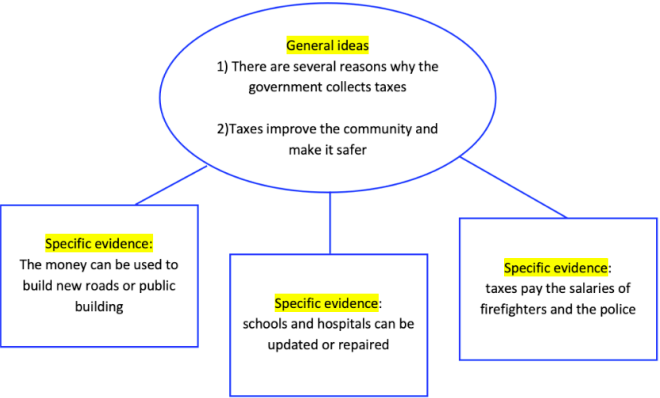
There are several reasons why the government collect taxes. Firstly, the money raised can be used to build new roads or public buildings. Secondly, existing infrastructure, such as schools and hospital, can be updated or repaired. Finally, these funds are needed to pay the salaries of all government workers, including firefighters and the police. Thus, taxes help improve the community while also making it safer.
The following image shows that we can categorize the ideas in this paragraph as either ‘general ideas’ or ‘supporting evidence’:
We can transfer this idea to help in the reading test: for matching headings questions, we need to identify the broader, more general idea within a paragraph or section of the passage.
3.0.1 Practice
Read through the paragraph and identify two ‘general ideas’ and three examples of ‘specific evidence’. :::{.callout-note} In many big cities, the population exceeds the number of flats and houses available, which means that many people do not have anywhere to live. This causes several problems. Firstly, it can put pressure on local charities, who have to find food and shelter for the homeless. If the government does not step in to help people who are struggling financially, then this puts even more stress on community programs and causes homelessness to rise even further. In addition, a lack of accommodation means that house prices and rents remain very high. Thus, housing problems have an impact on everyone in the community.
general ideas: many people do not have anywhere to live -> cause several problems
-> housing problems have an impact on everyone in the community
specific evidence:
put pressure on local charities
local charities have to find food and shelter for the homeless
lack of accommodation means that house prices and rents remain very high.
3.1 Points to notice
In almost every case in these paragraphs, the ideas were supported without using a separate sentence beginning with ‘For example, …’
The supporting evidence is relevant and focused, because of this, it supports the general ideas well.
For variety, we can either begin with the supporting evidence and then draw a conclusion from this:
A: These funds are used to pay the salaries of all government workers, including firefighters and the police. Thus, taxes help improve the community while also making it safer.
Or we can make the point and then show our evidence for this by giving an example:
B: Taxes help improve the community while also making it safer. For example, the funds are used to pay the salaries of government workers such as firefighters and the police.
Although we do not need to begin with a sentence with ‘For example’, sometimes, it is both helpful and necessary. Look at these two claims in the previous lesson, and the examples supporting them.
In academic writing, or when writing about a serious issue, we often begin by defining key terms. This can help to explain the context for the ideas in our argument. For example, if we are writing about the topic of ‘success’, we could begin by defining what this word means to us, or in our culture, which may be different to the examiner’s interpretation of the word.
Sometimes, we rephrase an idea in order to make it clearer. For example, in lesson 4, we wrote:
Many cities have more people than houses. This means that many people do not have anywhere to live.
She used these examples to show that her claims were true, but also to try to persuade us to take her claims seriously; putting each example into a separate sentence also helped to highlight it.
Including an example to make an idea clearer or help to show that the argument and point we are making is a valid one. Finish our paragraphs with a general point rather than with an example.
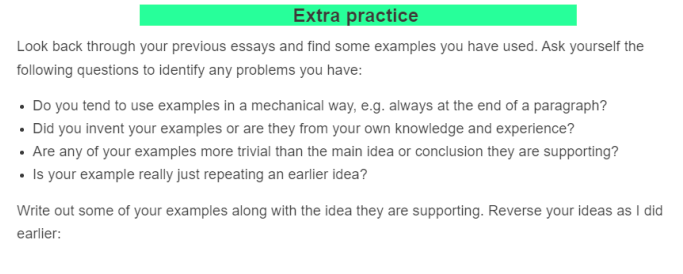
Instead of making a point and then giving an example:
Point: Taxes help improve the community while also making it safer.
Example: For example, the funds are used to pay the salaries of government worker such as firefighters and the police.
Begin with the example, and then draw a conclusion, or make a point about it, like this:
Example: These funds are used to pay the salaries of all government workers, including firefighters and the police.
Point: Thus, taxes help improve the community while also making it safer.
Notice that, here, we present our example without using the words ‘For example’, and then begin the next sentence with ‘Thus, …’ or ‘Therefore…’
Ask these questions to check whether our examples are acting as supporting evidence:
- Is the example relevant to the main idea of the paragraph and to the essay question?
- Does the point we are making follow on logically from our example?
- If not, what logical conclusion can we draw from our example? (i.e. What does our example show?) If this is not relevant to our main idea then we should not use it.
- Try to decide if our problem is with the main ideas and points we are making, the examples we have used to support them, or a combination of the two.