Lesson 8: PARAGRAPH WRITING
1 Progression and development within an argument
As we have seen, individual arguments are logically connected through meaning, the effective use of linking words and phrases, and referencing (using a synonym or pronoun). In an earlier example we looked at, one candidate wrote, ‘On the societal level, the results may be catastrophic if this is the case’. This argument can only show clear progression if the reader can easily understand what the terms ‘if this is the case’, and ‘the results’ refer to. If these ideas remain unclear, then the whole argument will also be unclear. Thus, problems with progression are often connected to problems with cohesive devices, and to referencing in particular. These issues need to be controlled throughout your essay to achieve band 7 or above.
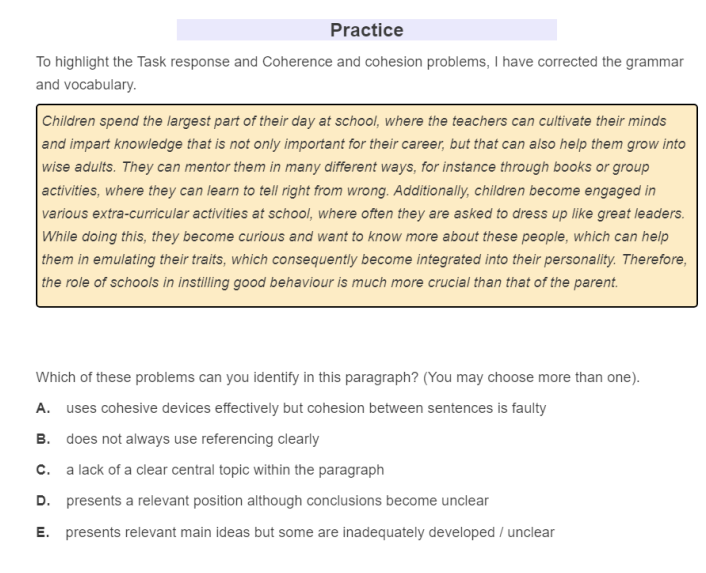 # Addressing Coherence and cohesion problems
- Use cohesive devices effectively but cohesion between sentences is faulty
- does not always use referencing clearly
This paragraph shows mixed success in using cohesive devices. Here are some examples where these are managed well
- Children spend the largest part of their day
- at school, where the teachers can
- knowledge that is not only important for their career, but that can also
- in many different ways, for instance through
- Additionally, children become
- at school, where often they
- dress up like great leaders. While doing this, they
- Therefore, the role of
Each of these examples is a clear signpost showing how two ideas are connected - this is what cohesion means. However, the use of referencing sometimes causes confusion, making it difficult to follow the ideas
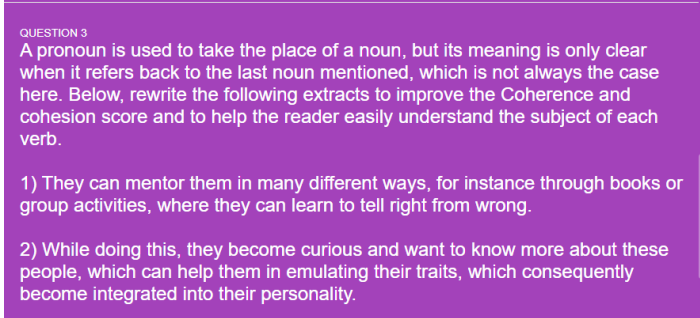
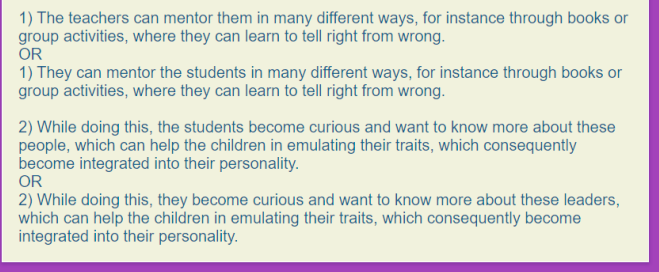
Even though we have fixed the referencing problems, the second sentence in the final exercises shows a further common coherence problem at band 6.5: it contains too many different ideas and so it is difficult to follow
While doing this, the students become curious and want to know more about these people, which can encourage the children to emulate their qualities, which consequently become integrated into their own personality.
This often happens when candidates write overly long, complex sentences.
Rewrite this extract to make it clearer. Try to do the following:
- split it into 2 or 3 separate sentences
- add a cohesive device to make the links clearer (e.g. a linking phrase and / or a reference)
- add modal verbs (can, might, may) to make the statements more cautious and less certain (hedging language)
While doing this, the students become curious and want to know more about these people. That thinking can encourage the children to emulate their qualities, which consequently become integrated into their own personality.
Weaknesses: Curiosity is not exactly ‘thinking’. A smoother option would be “This curiosity” or “Such interest”
While doing this, the students become curious and want to know more about these people. This curiosity can encourage the students to emulate those qualities, which then become integrated into their own personality.
->
While doing this, the students may become curious and want to know more about these people, which could encourage the children to emulate their qualities. These positive traits may even become integrated into their personality.
OR
While doing this, they may become curious and want to know more about these leaders, which could encourage the children to emulate their qualities. These positive traits may even become integrated into their personality.
The examiner must be able to follow your reasoning to give you a score of band 7 or above, the more difficult this is to do, the lower your score. The language you use (referencing, modal verbs, the length of your sentences) can have an impact on the examiner’s ability to follow your argument and understand your conclusions.
1.1 Reading aloud
Reading our writing out loud in can helps you to notice repetition more easily. Although we cannot do this in a test situation, practicing like this before our test should help us silently read over our work in a more focused way. We can make inner voice seem ‘louder’ when we want to do this type of final checking.
1.2 A lack of clear central topic
We have a method for writing a paragraph known as PEEL. The P refer to making a Point, which is then Explained, Expanded, then clearly Links back to the question. The Point and Link also act as a frame for the main idea within the paragraph, and these are a good way to ensure that we ‘present a clear central topic’ (Band 7) - provided, that these sentences accurately reflect the idea within the paragraph. Look at the first and last sentences in our updated paragraph. Do you think that these help to ‘present a clear central topic?’
Children spend the largest part of their day at school, where the teachers can cultivate their minds and fill them with knowledge that is not only important for their career, but that can also help them grow into wise adults. They can mentor the students in many different ways, for instance through books or group activities, where they can learn to tell right from wrong. In addition, children become engaged in various extra-curricular activities at school, where they are often asked to dress up like great leaders. While doing so, the students may become curious and want to know more about these people, which could encourage the children to emulate their qualities. These positive traits may even become integrated into their own personality. Therefore, the role of schools in instilling good behavior is much more crucial than that of the parent.
1.2.1 The first sentence
The first sentence tells us that the central topic in this paragraph will be: ‘school and teachers cultivating the minds of children to fill them with knowledge that is important for their career and helping them grow into wise adults.’ This is too long and complex to be a helpful signpost for the reader, but it also isn’t accurate - the children’s careers are never mentioned again. This sentence would work better as a second sentence, which shows a common problem - the first sentence of the paragraph is missing. The writer’s overall argument in this paragraph seems to be that ‘schools have a lot of influence on children’s behavior’, so this idea would produce a much more appropriate first sentence.
1.2.2 The final sentence
In the final sentence, the writer makes a good attempt at linking this paragraph to the question. However, it claims that the paragraph shows that ‘the role of schools in instilling good behavior is much more crucial than that of the parent’. This conclusion is not supported by the evidence given here and so remains unclear - the role of parents is not mentioned at all. A more appropriate sentence would be: Therefore, the role of schools in instilling good behavior is a significant one. Revising the first and last sentence so that they accurately reflect the ideas in the paragraph will significantly improve the Coherence and cohesion score here.
2 Addressing Task response problems
- Presents a relevant position although conclusions become unclear
- Presents relevant main ideas but some are inadequately developed / unclear
The argument being made in this paragraph is that ‘schools have a lot of influence on children’s behavior’. This is the main idea or conclusion that needs to be made clear. The ideas within the paragraph need to explain and support this point if we want to present an adequately developed response. Remember, these explanations must help the reader to understand why the writer believes this, and show that it is a valid argument or conclusion.
2.0.1 Practice
Complete the second column:
Schools have a lot of influence on children’s behaviour. Children spend the largest part of their day at school, where the teachers can cultivate their minds and fill them with knowledge that is not only important for their career, but that can also help them grow into wise adults. They can mentor the students in many different ways, for instance through books or group activities, where they can learn to tell right from wrong. In addition, children become engaged in various extra-curricular activities at school, where they are often asked to dress up like great leaders. While doing this, the students may become curious and want to know more about these people, which could encourage the children to emulate their qualities. These positive traits may even become integrated into their own personality Therefore, the role of schools in instilling good behaviour is a significant one.
| Main points or claims | Supporting evidence or explanation |
|---|---|
| Teachers can mentor children in different ways | for instance through books or group activities |
| Through books and group activities children can learn to tell right from wrong | |
| Children may emulate the qualities and positive traits of famous leaders and so their personality may change | dress up like great leaders |
| Main points or claims | Supporting evidence or explanation | |
|---|---|---|
| Teachers can mentor children in different ways | for instance through books or group activities | This explains when it will happen but not how. |
| Through books and group activities children can learn to tell right from wrong | (none) | How will they learn this? What is the connection between books or groups activities and learning right from wrong? |
| Children may emulate the qualities and positive traits of famous leaders and so their personality may change | dress up like great leaders | This does not seem very likely. Does putting on different clothes permanently change our personality and behavior? |
The explanation for the last idea (point 3) takes up almost half of the paragraph, yet the argument that children can permanently alter their personality and behavior by temporarily wearing different clothes still does not seem to be a valid one. In contrast, the ideas that are far more relevant to the main idea and the central topic (the role of the teacher in group activities and mentoring) are insufficiently developed or explained and so also remain unclear.
There is a further problem here. The writing task told us to discuss whether schools should be responsible for teaching good behavior, not just parents, but the writer has introduced a theme that is not relevant: children learning how to behave by copying famous leaders.
If the writer had applied critical thinking before writing he would have realized that this idea should be deleted. Instead, by persisting with it, and explaining it over several sentences, he has gradually moved further and further away from the issue in the question. This is what happens when you think as you write, and will occur no matter what your level is. As a result, even with the improvements we have made to language and Coherence and Cohesion, this paragraph still represents band 6 Task response, which helps explain why native speakers also struggle to score band 7 or above.
Schools have a great deal of influence on young children. From the age of five or six, children spend most of their day there, under the guidance of their teachers. Although we tend to think of education in terms of academic knowledge, this is only part of the picture. At school, children learn to make friends and to think independently. Through group activities, teachers can show them how to cooperate with others and play well together. Children quickly learn self-control, and realize that there is a right and wrong way to behave. In fact, if teacher did not correct poor behavior, the result would be a noisy disruptive classroom, where learning is almost impossible. Therefore, schools inevitably play a crucial role in shaping a child’s character.
Structure our paragraphs using PEEL. Begin by making a Point, which we then Explain, Expand, and then clearly Link our paragraph and argument back to the question. The Point and Link frame our paragraph. If they accurately reflect the main idea in the paragraph, they will ensure we ‘present a clear central topic’.
2.0.2 Point to notice about paragraph structure
- The first sentence in the paragraph introduces the main idea (the ‘central topic’ here is the influence that schools have on children). The final sentence reaches a conclusion based on the evidence provided within the paragraph, shows how this is linked to the question, and makes our position clear.
- We can see P and L in PEEL as overall conclusions about the argument within the paragraph. The first introduces these through a general statement or point, and the final sentence sums up the main argument in the paragraph, and shows that it is answering the question - in other words, why or how this is relevant to the question we have been given.
- Each idea between those sentence
- is relevant both to the question and to the main idea given in the first sentence
- helps support and explain the conclusions (P and L)
- is clearly connected
- is logically organized
When we can do something well, we can make it look easy. Do not underestimate the skill required to neatly sum up an argument or main point in this way - do not be fooled into thinking ‘the level here is too low because it is too easy to understand’. Those who believe this continue to write in a way that makes their central ideas, conclusions, and position unclear.
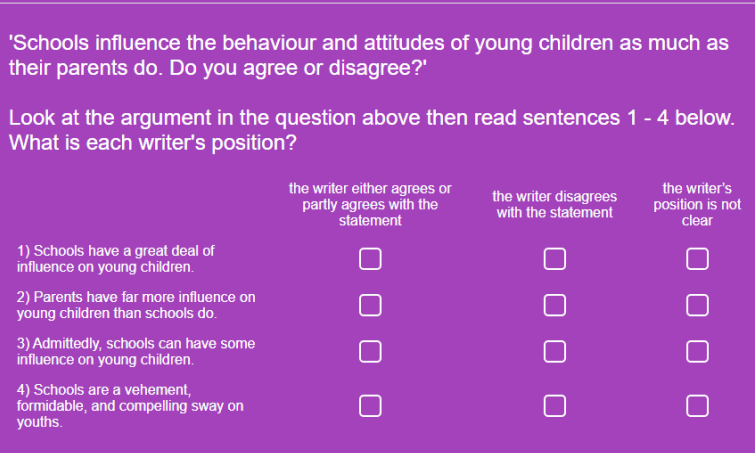
2.0.3 Point to notice
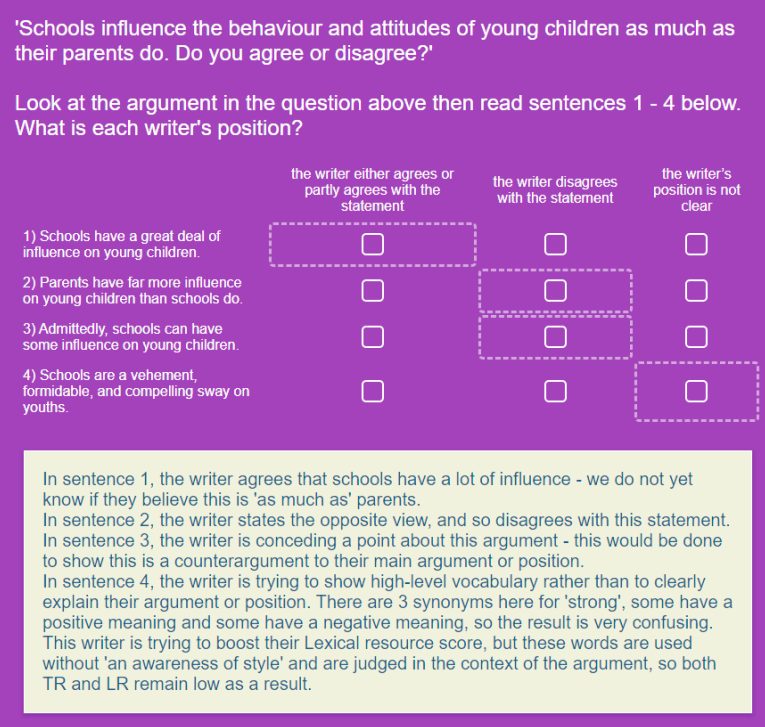
- The grammatical points are not used to boost the Grammatical accuracy and range score but to make the position and argument clear. Each grammar point serves this purpose. Look back at sentence 2 and 3 to see the role that conparatives, and modal verbs play in making the writer’s position verb clear.
- The vocabulary used also serves the same purpose. Compare sentence 1 to sentence 4. In sentence 1, the writer is focused on clearly communicating the message - ‘have a great deal of influence on’ conveys the message very clearly while also showing good collocation (i.e. uses the correct combination of words: _have an influence on__). In sentence 4, the writer may have intended to say, ‘Schools have a lot of influence on young children’, but in trying to score Lexical resource points by using ‘high level’ words instead, they lost the clarity that is needed to reach the higher bands.
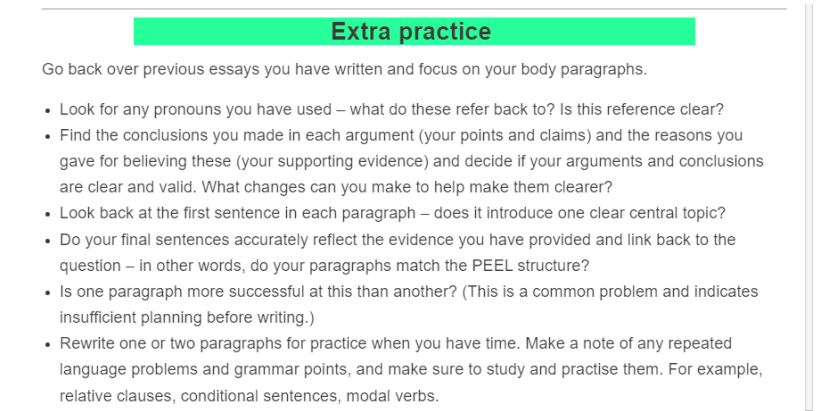
Extra practice Go back over previous essays you have written and focus on your body paragraphs. • Look for any pronouns you have used - what do these refer back to? Is this reference clear? • Find the conclusions you made in each argument (your points and claims) and the reasons you gave for believing these (your supporting evidence) and decide if your arguments and conclusions are clear and valid. What changes can you make to help make them clearer? • Look back at the first sentence in each paragraph - does it introduce one clear central topic? • Do your final sentences accurately reflect the evidence you have provided and link back to the question - in other words, do your paragraphs match the PEEL structure? • Is one paragraph more successful at this than another? (This is a common problem and indicates insufficient planning before writing.)| • Rewrite one or two paragraphs for practice when you have time. Make a note of any repeated language problems and grammar points, and make sure to study and practise them. For example, relative clauses, conditional sentences, modal verbs.